

Information services management represents a critical discipline that enables organisations to align their technology infrastructure, data resources, and service delivery capabilities with strategic business objectives. As professional teams increasingly depend on digital systems to manage projects, client relationships, and service delivery, the ability to govern, optimise, and evolve information services has become essential for maintaining competitive advantage. This comprehensive approach encompasses everything from IT service management frameworks to knowledge governance, data stewardship, and continuous improvement methodologies that ensure information assets deliver measurable business value.
Understanding Information Services Management in Modern Organisations
Information services management extends far beyond traditional IT support to encompass the entire lifecycle of information assets and technology-enabled services within an organisation. This discipline integrates governance frameworks, operational practices, and strategic planning to ensure that information systems support business goals effectively.
At its core, information services management addresses several interconnected domains. Technology infrastructure management ensures systems remain available, secure, and performant. Service delivery management focuses on how IT and information services are packaged, delivered, and supported for end users. Data governance establishes policies for data quality, access, and compliance, whilst knowledge management ensures organisational learning and expertise remain accessible.
The COBIT framework and resources from ISACA provide authoritative guidance on enterprise information governance, offering a structured approach to aligning IT objectives with business strategy. Professional teams benefit from adopting these frameworks because they create clarity around roles, responsibilities, and control objectives.
Key Components of Effective Information Services Management
Successful information services management requires attention to multiple dimensions simultaneously:
- Service catalogue management that documents available services, service levels, and support channels
- Incident and request management processes that ensure rapid response to user needs
- Change management protocols that balance innovation with operational stability
- Performance monitoring and reporting systems that track service quality metrics
- Security and compliance controls that protect sensitive information assets
- Vendor and contract management for third-party services and software
These components work together to create a cohesive operational framework. For organisations managing complex project management and professional services automation, integrating information services management practices ensures that technology platforms support rather than hinder workflow efficiency.

Governance Frameworks and Best Practices
Information services management relies heavily on established frameworks that codify industry best practices. The ITIL 4 framework from AXELOS has emerged as the dominant approach for IT service management, introducing concepts like value streams, service value chains, and continual improvement.
ITIL 4 emphasises several guiding principles relevant to professional teams:
- Focus on value – every service and activity should contribute to business outcomes
- Start where you are – assess current capabilities before implementing changes
- Progress iteratively with feedback – avoid big-bang transformations in favour of incremental improvements
- Collaborate and promote visibility – break down silos between teams and departments
- Think and work holistically – consider end-to-end service delivery, not isolated components
- Keep it simple and practical – eliminate unnecessary complexity and bureaucracy
- Optimise and automate – use technology to reduce manual effort and human error
These principles align naturally with modern project management methodologies. Teams using enterprise software management platforms benefit when information services management practices mirror the collaborative, iterative approaches they use for client delivery.
Aligning Information Services with Business Strategy
Strategic alignment represents one of the most challenging aspects of information services management. Technology teams often struggle to demonstrate how their work contributes to revenue generation, customer satisfaction, or competitive positioning.
| Alignment Approach | Description | Business Benefit |
|---|---|---|
| Service Portfolio Management | Categorise services by strategic value and resource consumption | Prioritise investment in high-value services |
| Business Capability Mapping | Link IT services to specific business capabilities | Identify gaps and redundancies in service provision |
| Demand Management | Forecast future service needs based on business plans | Proactive capacity planning and budget allocation |
| Value Stream Mapping | Document end-to-end processes from request to delivery | Eliminate waste and reduce service delivery time |
The AWS Cloud Adoption Framework data governance guidance offers practical advice for organisations managing information services in cloud environments, addressing data standards, stewardship responsibilities, and governance mechanisms specific to distributed systems.
Professional services organisations face unique alignment challenges because their information services must support both internal operations and client-facing delivery. When managing client work, time tracking, and billing, information systems need to serve multiple stakeholders with potentially conflicting requirements.
Operational Excellence in Service Delivery
Information services management achieves operational excellence through disciplined processes, clear metrics, and continuous improvement. Service level agreements (SLAs) define expectations for availability, response times, and resolution timeframes, creating accountability and enabling performance measurement.
Effective incident management represents a cornerstone of operational excellence. When users encounter service disruptions or system failures, rapid detection, diagnosis, and resolution minimise business impact. Mature information services management organisations implement:
- Multi-tier support structures that route issues to appropriate expertise levels
- Knowledge bases that capture solutions to common problems
- Root cause analysis processes that prevent recurring incidents
- Post-incident reviews that identify improvement opportunities
The Microsoft Operations Framework documentation provides practical guidance for implementing IT service management in Microsoft environments, covering operational processes, tooling approaches, and integration patterns.
Knowledge Management as a Service Multiplier
Research demonstrates strong connections between knowledge management and information services effectiveness. A 2023 study in Knowledge Management Research & Practice explores how ITSM and knowledge management practices reinforce each other to improve performance.
Knowledge management within information services management encompasses:
- Explicit knowledge capture through documentation, runbooks, and standard operating procedures
- Tacit knowledge sharing via communities of practice, mentoring, and collaborative problem-solving
- Knowledge retrieval systems that make information accessible when and where needed
- Continuous knowledge updating to reflect system changes and new learnings
For professional teams, effective knowledge management reduces dependency on specific individuals, accelerates onboarding, and improves service consistency. Teams using AI-powered service desk capabilities can augment human knowledge with machine learning that suggests solutions based on historical patterns.

Security and Risk Management Integration
Information services management cannot succeed without robust security and risk management practices. The NIST Cybersecurity Framework provides comprehensive guidance for integrating security controls into service delivery, covering five core functions: Identify, Protect, Detect, Respond, and Recover.
Security considerations permeate every aspect of information services management:
Access control and identity management ensure only authorised individuals can access specific systems and data. Data protection mechanisms safeguard information in transit and at rest through encryption and other technical controls. Vulnerability management identifies and remediates security weaknesses before exploitation. Incident response capabilities enable rapid containment and recovery when security events occur.
Risk management extends beyond cybersecurity to encompass operational risks like service availability, data integrity, and compliance violations. Effective information services management organisations maintain risk registers that document:
- Identified risks and their potential business impact
- Current controls and mitigation strategies
- Risk owners responsible for ongoing monitoring
- Planned improvements to reduce residual risk
Professional services firms managing confidential client data face heightened security requirements. Demonstrating robust information services management practices, including security controls and audit capabilities, often represents a competitive differentiator when pursuing enterprise clients.
Performance Measurement and Continuous Improvement
Quantifying information services management effectiveness requires carefully selected metrics that balance operational efficiency with strategic value delivery. Common performance indicators include:
| Metric Category | Example Metrics | Strategic Purpose |
|---|---|---|
| Service Availability | Uptime percentage, planned vs. unplanned downtime | Ensure business continuity and user productivity |
| Service Quality | First-contact resolution rate, mean time to resolution | Optimise user experience and operational efficiency |
| Cost Efficiency | Cost per ticket, cost per user, service cost trends | Demonstrate fiscal responsibility and identify optimisation opportunities |
| Customer Satisfaction | Net Promoter Score, satisfaction ratings, complaint volumes | Align services with user expectations and business needs |
| Strategic Alignment | Services supporting strategic initiatives, innovation rate | Ensure IT investment drives business objectives |
These metrics should inform regular service reviews where stakeholders evaluate performance, discuss challenges, and identify improvement priorities. Effective reporting capabilities transform raw data into actionable insights that drive decision-making.
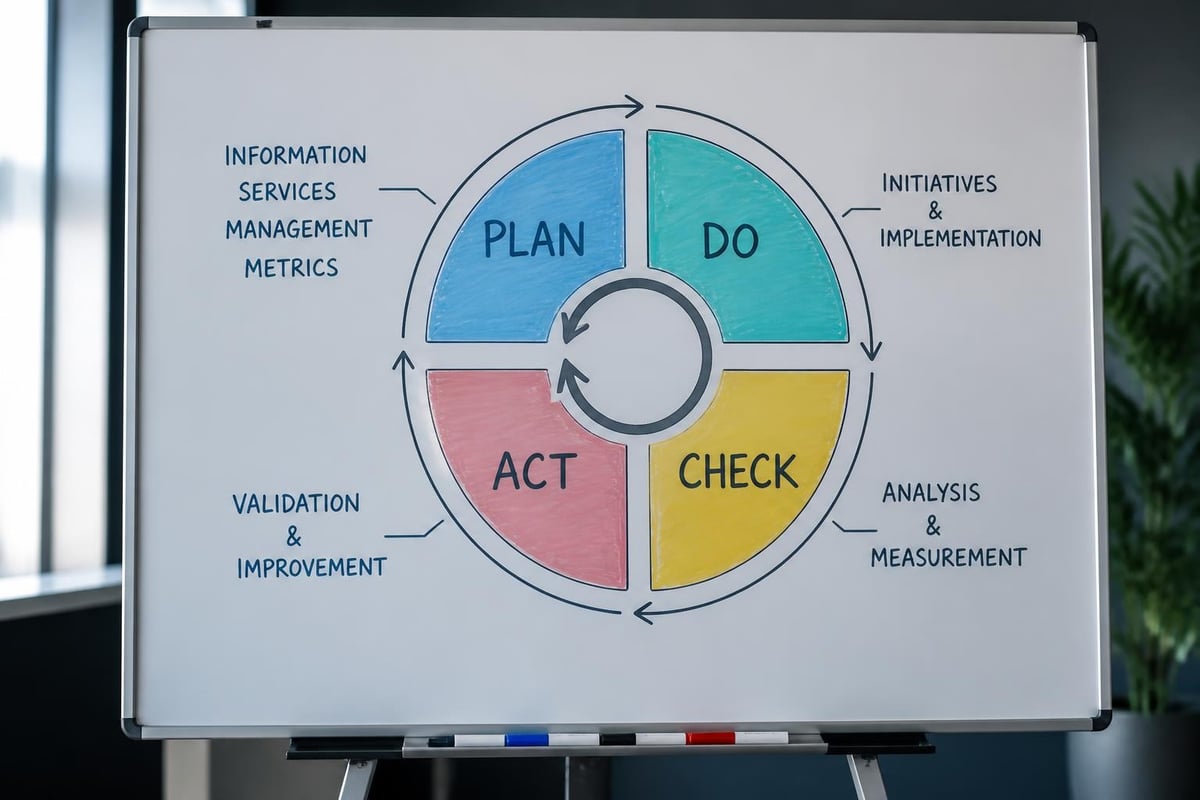
Continuous improvement in information services management draws from methodologies like Lean, Six Sigma, and Agile. Process optimisation initiatives might target:
- Reducing approval bottlenecks in change management workflows
- Automating repetitive tasks through scripting or robotic process automation
- Consolidating redundant tools to reduce complexity and licensing costs
- Improving knowledge base searchability to accelerate self-service resolution
Research on transforming information systems management through digital engineering integration explores modern approaches to service delivery and governance that leverage cloud platforms, automation, and DevOps practices.
Technology Platforms Supporting Information Services Management
Selecting appropriate technology platforms represents a critical decision in information services management strategy. Purpose-built ITSM solutions offer comprehensive capabilities but may introduce complexity. Integrated work management platforms provide broader functionality across project management, service delivery, and business operations.
Key capabilities to evaluate include:
- Service request and incident management with configurable workflows and automation
- Asset and configuration management to maintain accurate system inventories
- Knowledge base and self-service portal enabling user autonomy
- Reporting and analytics for performance monitoring and trend analysis
- Integration capabilities to connect with other business systems
- Mobile access supporting remote and field-based service delivery
Professional teams benefit from platforms that unify information services management with project management, CRM, and professional services automation. This integration eliminates data silos, reduces context switching, and provides holistic visibility across all work streams.
When evaluating platforms, consider total cost of ownership beyond initial licensing fees. Implementation effort, customisation requirements, training needs, and ongoing maintenance all contribute to long-term costs. Avoiding tool overload through consolidated platforms often delivers better user adoption and operational efficiency than best-of-breed approaches requiring extensive integration.
Organisational Change and Cultural Considerations
Implementing effective information services management requires organisational change that extends beyond process documentation and technology deployment. Cultural factors significantly influence adoption and long-term sustainability.
Service-oriented mindset represents a fundamental cultural shift for many IT organisations. Rather than viewing themselves as technology custodians, successful information services teams embrace service provider roles focused on enabling business outcomes. This perspective influences everything from how services are designed to how performance is measured.
Collaboration between business and IT breaks down traditional barriers that create misalignment. When business stakeholders actively participate in service design, priority setting, and performance reviews, information services management naturally aligns with organisational needs.
Continuous learning culture ensures teams remain current with evolving technologies, emerging threats, and changing business requirements. Professional development, certifications, and knowledge sharing mechanisms all contribute to organisational capability.
Change management practices support information services management transformation by:
- Building awareness of why changes are necessary and how they benefit stakeholders
- Creating desire among affected individuals to support and participate in changes
- Developing knowledge about how to implement new processes and tools
- Enabling ability through training, resources, and support systems
- Reinforcing changes to prevent regression to previous patterns
Teams experienced with business process and IT integration recognise that technology changes succeed or fail based primarily on human factors rather than technical capabilities.
Future Trends in Information Services Management
Information services management continues evolving in response to technological innovation and changing business models. Several trends are reshaping the discipline:
Artificial intelligence and machine learning increasingly automate routine tasks like ticket categorisation, initial diagnosis, and solution recommendation. These technologies augment rather than replace human expertise, handling high-volume, low-complexity work whilst freeing skilled staff for strategic initiatives.
Cloud-native service delivery fundamentally changes infrastructure management, shifting focus from hardware provisioning to cloud resource optimisation, multi-cloud orchestration, and FinOps practices that balance performance with cost efficiency.
Everything-as-a-Service models blur traditional boundaries between infrastructure, platforms, and applications. Information services management must adapt to environments where business capabilities are consumed as services rather than owned as assets.
Experience-centric design prioritises user experience and business outcomes over technical metrics. Modern information services management emphasises journey mapping, persona development, and experience-level agreements that complement traditional SLAs.
Integration ecosystems replace monolithic systems with interconnected platforms that share data and functionality. Platform interoperability becomes essential as organisations assemble best-fit solutions rather than adopting single-vendor suites.
Professional services organisations particularly benefit from these trends because they enable more flexible, scalable, and client-responsive information services that adapt to project-based work patterns and varying capacity requirements.
Effective information services management aligns technology capabilities with business strategy whilst maintaining operational excellence through disciplined processes, robust governance, and continuous improvement. For professional teams managing complex client work, integrated platforms that combine information services management with project delivery, time tracking, and billing create unprecedented visibility and control. Chronodesk provides exactly this unified approach, enabling teams to manage service requests, projects, and client relationships within a single comprehensive platform designed specifically for professional services organisations.