

Enterprise software development represents one of the most complex and consequential undertakings in modern business technology. Unlike consumer applications or small-scale tools, enterprise systems must serve hundreds or thousands of users simultaneously whilst maintaining strict security standards, regulatory compliance, and integration with legacy infrastructure. The stakes are considerably higher, the timelines longer, and the technical challenges more nuanced. This comprehensive guide explores the architectural patterns, security frameworks, and delivery strategies that define successful enterprise software development in 2026.
Understanding Enterprise Software Development Complexity
Enterprise software development differs fundamentally from traditional application development in scale, scope, and organisational impact. These systems typically support mission-critical business processes across multiple departments, geographies, and user roles.
The complexity stems from several interconnected factors. Data volume and variety require sophisticated database architectures and caching strategies. User concurrency demands horizontal scalability and load balancing. Integration requirements necessitate robust APIs and middleware layers that connect with existing enterprise resource planning systems, customer relationship management platforms, and legacy databases.
Modern enterprise software development must also account for multi-tenancy requirements, where a single instance serves multiple organisations or business units whilst maintaining strict data isolation. This architectural pattern reduces infrastructure costs but introduces complexity in authentication, authorisation, and data partitioning.

Key Characteristics of Enterprise Systems
Enterprise applications share several defining attributes that distinguish them from consumer-grade software:
- High availability requirements (99.9% uptime or greater)
- Complex permission structures with role-based access control
- Audit trails for regulatory compliance and forensic analysis
- Workflow automation spanning multiple departments and approval chains
- Advanced reporting and business intelligence capabilities
- Disaster recovery and business continuity planning
The features every enterprise should demand from a work management platform reflect these core characteristics, emphasising integration, security, and operational visibility.
Architectural Patterns for Enterprise Scale
Selecting the appropriate architectural pattern represents one of the most consequential decisions in enterprise software development. The wrong choice can constrain scalability, increase maintenance costs, and limit future extensibility.
Microservices Architecture
Microservices have become increasingly prevalent in enterprise software development, offering modularity and independent deployment capabilities. According to research from industry practitioners, organisations adopting microservices report improved team autonomy and deployment frequency, though they also encounter challenges with distributed system complexity and operational overhead.
The microservices pattern decomposes applications into small, independently deployable services that communicate through well-defined APIs. Each service owns its data store and can be developed, tested, and deployed independently.
| Microservices Benefits | Microservices Challenges |
|---|---|
| Independent scaling of components | Increased operational complexity |
| Technology diversity across services | Distributed system debugging |
| Faster deployment cycles | Network latency and reliability |
| Team autonomy and ownership | Data consistency across services |
| Resilience through isolation | Higher infrastructure costs |
Data Architecture Considerations
As enterprise systems grow, traditional centralised data architectures often become bottlenecks. The concept of a data mesh offers an alternative approach, treating data as a product owned by domain teams rather than a centralised asset managed by a single data team.
This decentralised approach aligns well with microservices architectures and supports the organisational structure of large enterprises. Domain teams take responsibility for data quality, governance, and accessibility within their bounded contexts.
Security and Compliance in Enterprise Software Development
Security cannot be an afterthought in enterprise software development. Modern development practices embed security throughout the software development lifecycle, a discipline known as DevSecOps.
Implementing DevSecOps Practices
The NIST guidance on secure software development provides a comprehensive framework for integrating security controls into development workflows. This includes threat modelling during design, static application security testing in build pipelines, and dynamic scanning in staging environments.
Core DevSecOps practices include:
- Shift-left security – identifying vulnerabilities early in development
- Automated security scanning in continuous integration pipelines
- Infrastructure as code with security policies enforced through code review
- Container security scanning base images and runtime configurations
- Secrets management using dedicated vaults rather than hardcoded credentials
The OWASP Top 10 CI/CD Security Risks highlights common vulnerabilities in build and deployment pipelines, including insufficient pipeline access controls, dependency chain abuse, and insecure system configuration.

Managing Third-Party Dependencies
Enterprise software development relies heavily on open-source libraries and commercial components. Managing these dependencies requires systematic approaches to vulnerability scanning, licence compliance, and version management.
Establishing a software bill of materials (SBOM) provides visibility into all components and their dependencies, enabling rapid response when vulnerabilities are disclosed. The Security Engineering Framework from Carnegie Mellon’s Software Engineering Institute offers guidance on supply chain risk management and component governance.
Developer Experience and Productivity
Enterprise software development productivity depends critically on developer experience. Research from Microsoft on DevEx in action demonstrates that investments in developer tooling, documentation, and feedback loops yield measurable improvements in delivery speed and code quality.
Optimising Feedback Loops
Short feedback loops enable developers to identify and correct issues quickly. Enterprise software development platforms should provide:
- Fast local development environments with containerised dependencies
- Automated testing at multiple levels (unit, integration, end-to-end)
- Preview environments for every pull request
- Comprehensive observability linking code changes to production behaviour
The CNCF guide to observability engineering emphasises structured logging, distributed tracing, and metrics collection as foundational practices for understanding system behaviour in production.
Platform Engineering for Self-Service
Platform engineering teams create internal developer platforms that abstract infrastructure complexity and enable application teams to provision resources, deploy services, and access observability data through self-service interfaces.
This approach reduces cognitive load on application developers whilst maintaining guardrails around security, compliance, and cost management. Platforms codify organisational standards and best practices, reducing variance across teams.
Cloud-Native Development Strategies
Cloud-native architectures have become the default choice for new enterprise software development initiatives. The CNCF’s 2024 Annual Survey reveals widespread adoption of Kubernetes, service meshes, and serverless technologies across enterprises of all sizes.
Kubernetes and Container Orchestration
Kubernetes provides a consistent platform for deploying and managing containerised applications across cloud providers and on-premises infrastructure. This portability reduces vendor lock-in and enables hybrid and multi-cloud strategies.
Key Kubernetes capabilities for enterprise software development:
- Declarative configuration and infrastructure as code
- Automatic scaling based on metrics
- Rolling updates and rollback mechanisms
- Service discovery and load balancing
- Configuration and secrets management
The Google Cloud guidance on CI/CD integration demonstrates how enterprise teams can build reproducible pipelines that deploy to Kubernetes clusters with confidence.
Serverless and Event-Driven Architectures
Serverless computing allows developers to focus on business logic whilst cloud providers manage infrastructure scaling and availability. Event-driven architectures built on serverless functions enable loose coupling between components and support asynchronous processing patterns.
These patterns work particularly well for workflow automation, data processing pipelines, and integration scenarios common in enterprise software development. However, organisations must carefully consider cold start latency, vendor-specific APIs, and debugging complexity.
Agile and Lean Development Practices
Enterprise software development has largely abandoned waterfall methodologies in favour of iterative, incremental approaches that deliver value continuously rather than in big-bang releases.
Understanding agile, waterfall, and lean methodologies helps teams select appropriate practices for their context. Pure agile may not suit all enterprise scenarios, particularly when regulatory requirements demand extensive documentation or when coordinating across many interdependent teams.
Scaling Agile Across Large Organisations
Frameworks like SAFe (Scaled Agile Framework) and LeSS (Large-Scale Scrum) provide structures for coordinating multiple agile teams working on related products. These frameworks introduce concepts like:
- Programme increments synchronising delivery across teams
- Architectural runways preparing infrastructure for upcoming features
- Communities of practice sharing knowledge across teams
- Value stream mapping identifying bottlenecks and waste
Reducing uncertainty through good project management becomes even more critical at enterprise scale, where dependencies multiply and coordination overhead increases.
Managing Technical Debt
Technical debt accumulates in all long-lived codebases, representing shortcuts and compromises made under time pressure. Enterprise software development must balance feature delivery with debt reduction to maintain long-term sustainability.
Techniques for managing technical debt include:
- Allocating dedicated capacity (e.g., 20% of sprint capacity) for refactoring
- Tracking debt items in the same backlog as features
- Measuring code quality metrics to identify problem areas
- Architectural decision records documenting context and trade-offs
Integration and Interoperability
Enterprise software rarely exists in isolation. Most enterprise software development projects require extensive integration with existing systems, third-party services, and partner platforms.
API Design and Management
Well-designed APIs form the foundation of system integration. RESTful APIs remain popular, though GraphQL offers advantages for complex data requirements and gRPC provides performance benefits for internal service communication.
API design principles for enterprise systems:
- Consistent naming conventions and resource modelling
- Versioning strategies that prevent breaking changes
- Comprehensive documentation with example requests
- Rate limiting and quota management
- Authentication and authorisation controls
Event Streaming and Message Queues
Asynchronous integration patterns using event streaming platforms (like Apache Kafka) or message queues enable loose coupling between systems. Events capture state changes as they occur, allowing multiple consumers to react independently.
This pattern supports several enterprise scenarios: audit logging, data synchronisation across systems, workflow orchestration, and real-time analytics. The trade-off involves increased operational complexity and the need for eventual consistency rather than immediate consistency.
Technology Selection and Modernisation
Choosing technologies for enterprise software development requires balancing innovation against stability and organisational capability. The Thoughtworks Technology Radar provides practitioner guidance on which technologies to adopt, trial, assess, or hold.
Evaluating New Technologies
Enterprise organisations should establish formal evaluation processes for new technologies, considering:
- Maturity and stability of the technology and ecosystem
- Vendor viability and community support
- Skills availability within the organisation and job market
- Licensing costs and total cost of ownership
- Security posture and vulnerability history
- Integration compatibility with existing systems
When mainstream work tools hold your business back, organisations must critically assess whether popular tools truly meet enterprise requirements or whether more specialised platforms better serve their needs.
Legacy System Modernisation
Most enterprise software development involves maintaining and modernising legacy systems alongside building new capabilities. Strategies include:
Strangler fig pattern – gradually replacing legacy functionality with new services API facade – wrapping legacy systems with modern interfaces Data replication – synchronising data between old and new systems during transition Feature toggles – controlling rollout of new functionality whilst maintaining fallbacks
Quality Assurance and Testing Strategies
Enterprise software development demands rigorous testing across multiple dimensions: functional correctness, performance under load, security resilience, and compatibility across environments.
Test Automation Pyramid
The test automation pyramid guides investment across testing levels:
| Test Level | Quantity | Speed | Scope | Confidence |
|---|---|---|---|---|
| Unit tests | Highest | Fastest | Narrow | Low |
| Integration tests | Medium | Medium | Medium | Medium |
| End-to-end tests | Lowest | Slowest | Broad | High |
Unit tests verify individual functions and classes in isolation. Integration tests validate interactions between components. End-to-end tests exercise complete user journeys through the system.
Performance and Load Testing
Enterprise systems must perform well under realistic and peak load conditions. Performance testing should begin early in development rather than only before release.
Performance testing approaches:
- Baseline testing – establishing performance under normal load
- Stress testing – identifying breaking points under extreme load
- Soak testing – running sustained load to identify memory leaks
- Spike testing – validating behaviour during sudden traffic increases
Team Structure and Communication
Enterprise software development involves large, distributed teams with varying specialisations. Organisational structure significantly impacts delivery effectiveness.
Cross-Functional Teams
Modern enterprise software development favours cross-functional teams that include developers, testers, designers, and product managers. This structure reduces handoffs and enables teams to deliver features end-to-end.
Conway’s Law observes that system architectures mirror organisational communication structures. Organisations adopting microservices often restructure teams around service boundaries, giving each team full ownership of specific capabilities.
Remote and Distributed Development
The shift towards remote work has accelerated since 2020, with many enterprise software development teams now permanently distributed. This requires intentional practices around:
- Asynchronous communication through documentation and decision records
- Overlapping working hours for real-time collaboration when needed
- Video-first meetings with clear agendas and outcomes
- Digital whiteboarding tools for design sessions
Strategic time management becomes crucial when coordinating across time zones and managing the additional communication overhead of distributed teams.
Continuous Delivery and Deployment
Enterprise software development has embraced continuous delivery, though continuous deployment (automatic production release) remains less common in regulated industries.
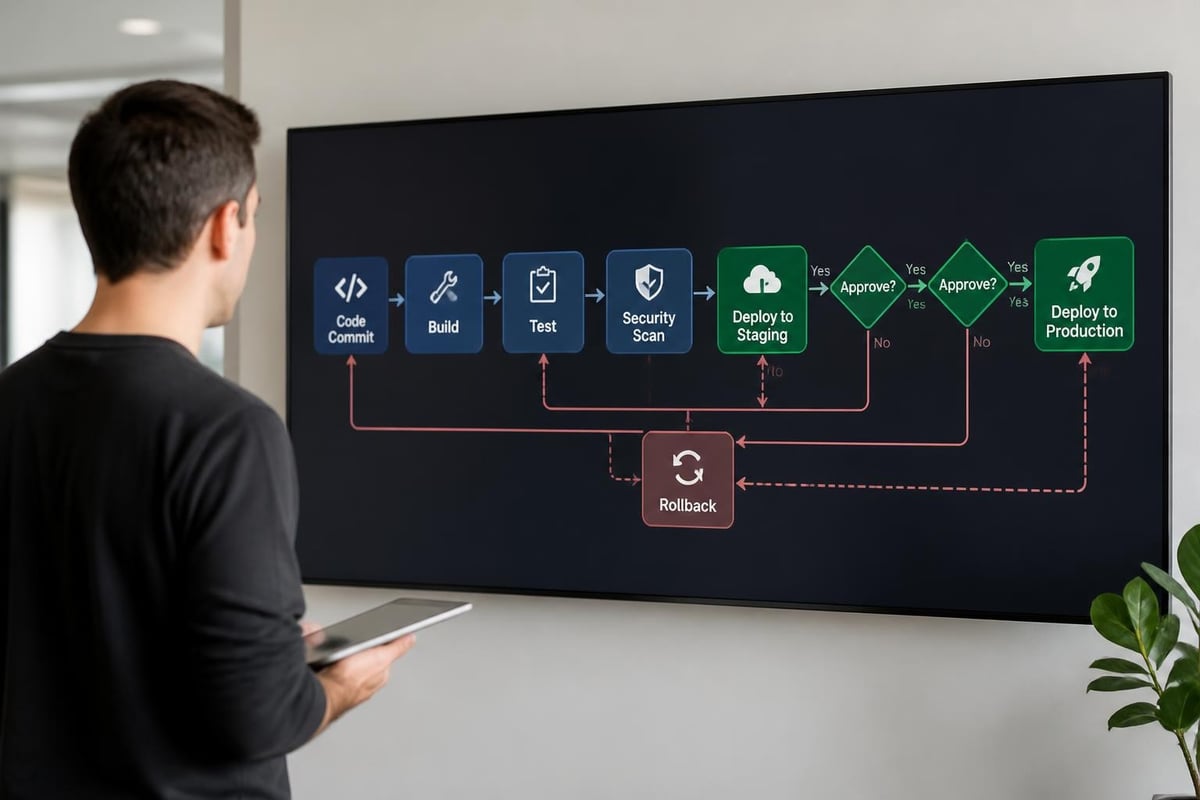
Pipeline Architecture
Deployment pipelines automate the path from code commit to production release. A mature pipeline includes:
- Source control integration and branch policies
- Automated build and compilation
- Unit and integration test execution
- Security scanning and compliance checks
- Artifact packaging and versioning
- Environment promotion with approval gates
- Deployment automation and smoke tests
Release Strategies
Different release strategies manage risk and enable controlled rollout:
Blue-green deployment – maintaining two identical environments and switching traffic Canary releases – gradually routing traffic to new versions Feature flags – decoupling deployment from release, enabling targeted rollout Rolling updates – incrementally replacing instances with new versions
Managing when sprints lose speed often requires examining deployment processes and identifying bottlenecks that slow delivery cycles.
Operational Excellence and Support
Enterprise software development extends beyond initial release. Production operations, incident management, and continuous improvement form essential components of software delivery.
Observability and Monitoring
Comprehensive observability enables teams to understand system behaviour and quickly diagnose issues. The three pillars of observability (metrics, logs, and traces) provide complementary views into system health and behaviour.
Modern platforms instrument applications automatically, capturing performance metrics, error rates, and business metrics. Distributed tracing follows requests across multiple services, revealing bottlenecks and failures in complex workflows.
Incident Response
Well-defined incident response processes minimise impact when issues occur. Enterprise organisations typically implement:
- On-call rotations distributing responsibility across teams
- Escalation procedures engaging appropriate expertise quickly
- Blameless post-mortems learning from incidents without punishment
- Runbooks documenting common issues and remediation steps
Platform Integration and Ecosystem
Enterprise software development increasingly involves building platforms that integrate multiple tools and data sources. Work better together by ensuring platforms talk to each other, reducing manual data entry and context switching.
Platforms like Chronodesk demonstrate this integration approach, connecting project management, service desk, time tracking, and billing within a unified environment. This reduces the hidden cost of tool overload whilst maintaining the specialised capabilities teams require.
Building Integration Strategies
Successful integration requires:
- Webhook support for real-time event notifications
- OAuth authentication for secure third-party access
- GraphQL or REST APIs with comprehensive documentation
- Rate limiting to prevent abuse whilst supporting legitimate use
- Sandbox environments for testing integrations before production
Enterprise software development demands rigorous attention to architecture, security, quality, and operations whilst maintaining delivery velocity. The practices outlined here-from DevSecOps and microservices to observability and continuous delivery-enable organisations to build robust systems that serve business needs whilst managing complexity and risk. Chronodesk provides the integrated platform professional teams need to manage complex projects, client work, and service delivery within a structured, secure environment designed for enterprise scale.