

Daily project management represents the operational heartbeat of successful project delivery. Whilst strategic planning and milestone tracking capture headlines, the unglamorous work of managing projects day by day determines whether ambitious plans translate into tangible results. Professional teams that master their daily routines consistently outperform those who rely solely on periodic reviews and reactive firefighting. The difference lies not in working longer hours but in establishing structured rhythms that surface problems early, maintain momentum, and create space for both focused work and collaborative problem-solving.
The Foundation of Daily Project Management Practices
Effective daily project management begins with clarity about what constitutes a productive day. Rather than measuring activity or hours logged, high-performing teams define daily success through progress on critical path items, resolution of blockers, and quality of handoffs between team members.
Establishing Morning Rituals That Set Direction
The first hour of each working day establishes the tone and priorities for everything that follows. Project managers who invest time in a structured morning routine consistently report higher team satisfaction and fewer mid-day crises. This routine typically includes reviewing overnight updates, scanning the critical path for emerging risks, and preparing for the daily standup or coordination meeting.
Key elements of an effective morning routine:
- Review yesterday’s commitments and outcomes
- Identify today’s three most critical deliverables
- Check for external dependencies or stakeholder requests
- Prepare questions and decisions for the daily coordination meeting
- Block focus time for deep work on complex tasks
Teams working across time zones face additional complexity in their morning routines. A project manager in London coordinating with developers in Singapore and clients in New York must structure their day to accommodate multiple handoff windows whilst preserving blocks for strategic work.

The Daily Standup: Purpose Beyond Process
Daily standups have become ubiquitous in project management, yet many teams struggle to extract meaningful value from these ceremonies. The Harvard Business Review analysis of stand-up meetings suggests that poorly executed standups can actually inhibit deeper thinking and innovation, particularly when they become rote status reporting rather than genuine coordination.
Effective daily standups serve three specific purposes: synchronizing work streams, surfacing blockers before they cascade, and enabling rapid decision-making. These meetings should rarely exceed 15 minutes for teams under eight people, scaling to 20-25 minutes for larger groups.
| Meeting Element | Time Allocation | Primary Purpose |
|---|---|---|
| Progress updates | 5-8 minutes | Information sharing, identifying wins |
| Blocker discussion | 3-5 minutes | Surfacing obstacles, assigning ownership |
| Coordination needs | 3-5 minutes | Handoffs, dependencies, resource conflicts |
| Parking lot items | 2-3 minutes | Capture topics needing deeper discussion |
Teams using platforms like Chronodesk can enhance their standups by reviewing consolidated dashboards that show real-time progress across projects, service requests, and client deliverables, reducing the time spent on basic status reporting.
Structuring the Working Day for Maximum Impact
Beyond the morning standup, daily project management requires intentional structure throughout the working hours. The most effective project managers create what researchers at MIT Sloan describe as small daily routines that improve both remote and co-located team effectiveness.
Time Blocking and Focus Periods
Professional teams increasingly adopt time blocking as a core daily project management technique. This approach involves dedicating specific hours to particular types of work: deep focus for complex tasks, collaboration windows for meetings and coordination, and administrative time for updates and planning.
A typical time-blocked day for a project manager might include:
- Morning coordination (08:00-09:30): Standup, quick decisions, stakeholder check-ins
- Deep work block (09:30-12:00): Strategic planning, complex problem-solving, proposal writing
- Collaboration window (13:00-15:30): Client meetings, team workshops, cross-functional coordination
- Administrative work (15:30-17:00): Status updates, timesheet review, tomorrow’s preparation
- Buffer time (17:00-17:30): Handling urgent items, clearing small tasks
This structure prevents the constant context-switching that destroys productivity whilst ensuring adequate availability for both planned and emergent needs.
Managing the Mid-Day Energy Dip
Energy management matters as much as time management in daily project management. Most professionals experience reduced cognitive capacity in the early afternoon, typically between 14:00 and 15:30. Rather than fighting this natural rhythm, experienced project managers schedule lower-stakes activities during these hours.
Optimal mid-afternoon activities include:
- Routine administrative tasks
- Email processing and response
- Straightforward updates to project documentation
- Brief one-on-one check-ins that don’t require complex decision-making
- Planning and organizing for the following day
Teams that acknowledge and work with natural energy patterns report higher quality output and reduced burnout compared to those who expect consistent high performance across all hours.
Daily Monitoring and Course Correction
Effective daily project management requires constant feedback loops that reveal when work is drifting from plan. Waiting for weekly reviews to discover problems ensures those problems have already compounded into crises.
Real-Time Progress Tracking
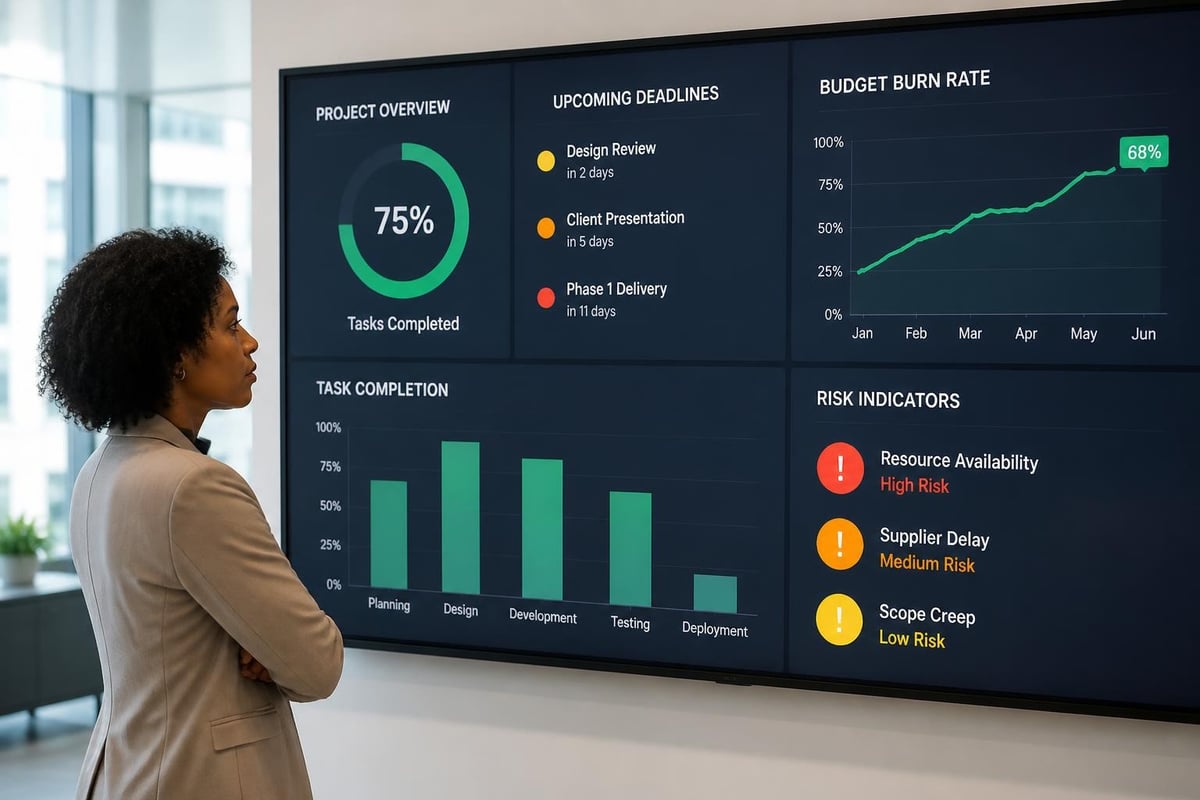
Modern project management platforms enable real-time visibility into work progress without requiring manual status reports. When integrated properly with daily workflows, these tools surface variances from plan as they emerge rather than days later. The 6 features every enterprise should demand from their work management platform include real-time dashboards, automated alerts, and consolidated views across projects and teams.
Daily monitoring should focus on leading indicators rather than lagging metrics. Leading indicators reveal emerging problems whilst there’s still time to intervene; lagging indicators merely confirm what already happened.
| Metric Type | Example | Update Frequency | Action Threshold |
|---|---|---|---|
| Leading | Tasks starting on schedule | Hourly | <80% adherence |
| Leading | Blocker resolution time | Per occurrence | >4 hours unresolved |
| Leading | Quality review pass rate | Per submission | <85% first-pass approval |
| Lagging | Milestone completion | Weekly | Any missed deadline |
| Lagging | Budget variance | Weekly | >5% over plan |
The Lean Daily Management Approach
The Lean Enterprise Institute’s coverage of Lean Daily Management provides valuable insights for project teams seeking to connect daily actions to strategic objectives. This approach emphasizes visual management boards, tiered huddles, and systematic problem-solving routines that surface issues and drive continuous improvement.
In a Lean daily management system, teams conduct brief huddles at multiple levels: individual teams review their boards first, then team leads participate in a second-tier huddle, which feeds into department-level coordination. This cascading structure ensures information flows both up and down the organisation efficiently.
Professional services teams adapting these principles for project management for professional services focus on client deliverables, utilisation rates, and quality metrics as their primary daily management targets.
End-of-Day Routines and Handoffs
Whilst morning rituals establish direction, end-of-day practices ensure continuity and enable effective handoffs. Teams working across time zones particularly benefit from structured closing routines that capture progress, document decisions, and prepare the next shift or the following day.
Documentation and Knowledge Transfer
Daily project management fails when knowledge remains trapped in individual heads. End-of-day documentation needn’t be extensive, but it must capture critical context: decisions made, assumptions validated or challenged, obstacles encountered, and next actions required.
Essential end-of-day documentation includes:
- Updated task status with actual progress vs. planned
- Brief notes on any scope or requirement clarifications
- Decisions made and rationale (especially when deviating from plan)
- Identified risks or dependencies for team awareness
- Clear handoff notes for colleagues in other time zones
Teams distributed across multiple time zones create “virtual handshakes” through these documented handoffs. A developer finishing work in Melbourne leaves detailed notes that a counterpart in London reviews upon starting their day, ensuring 24-hour progress without requiring synchronous overlap.
Preparing Tomorrow’s Focus
Effective project managers end each day by defining tomorrow’s priorities. This practice prevents decision fatigue the following morning and enables an immediate start on high-value work rather than spending the first hour figuring out what to do.
The simple act of writing down tomorrow’s top three priorities before closing the laptop creates mental clarity and reduces evening rumination about work. Research consistently shows that externalising commitments in this way improves both sleep quality and next-day execution.
Tools and Technology for Daily Project Management
The right tools can amplify effective daily project management practices, whilst the wrong tools create friction and overhead. Professional teams require platforms that integrate naturally into daily workflows rather than demanding additional administrative work.
Consolidated Work Platforms vs. Tool Sprawl
Many organisations suffer from what might be termed “tool fragmentation,” where project tasks live in one system, client communications in another, time tracking in a third, and service requests in yet another platform. This hidden cost of tool overload manifests most painfully in daily project management, where team members waste hours each week switching between systems and manually reconciling information.
Comprehensive platforms that unite project management, CRM, service desk, and professional services automation in a single environment eliminate much of this daily friction. When teams can see client context, project status, open service requests, and time allocation in one view, they make better decisions faster.
Automation and AI in Daily Routines
Recent academic research on rethinking daily standups explores how AI-assisted analysis can identify improvement opportunities in agile development teams. Beyond standups, artificial intelligence increasingly supports daily project management through intelligent routing, anomaly detection, and predictive resource allocation.
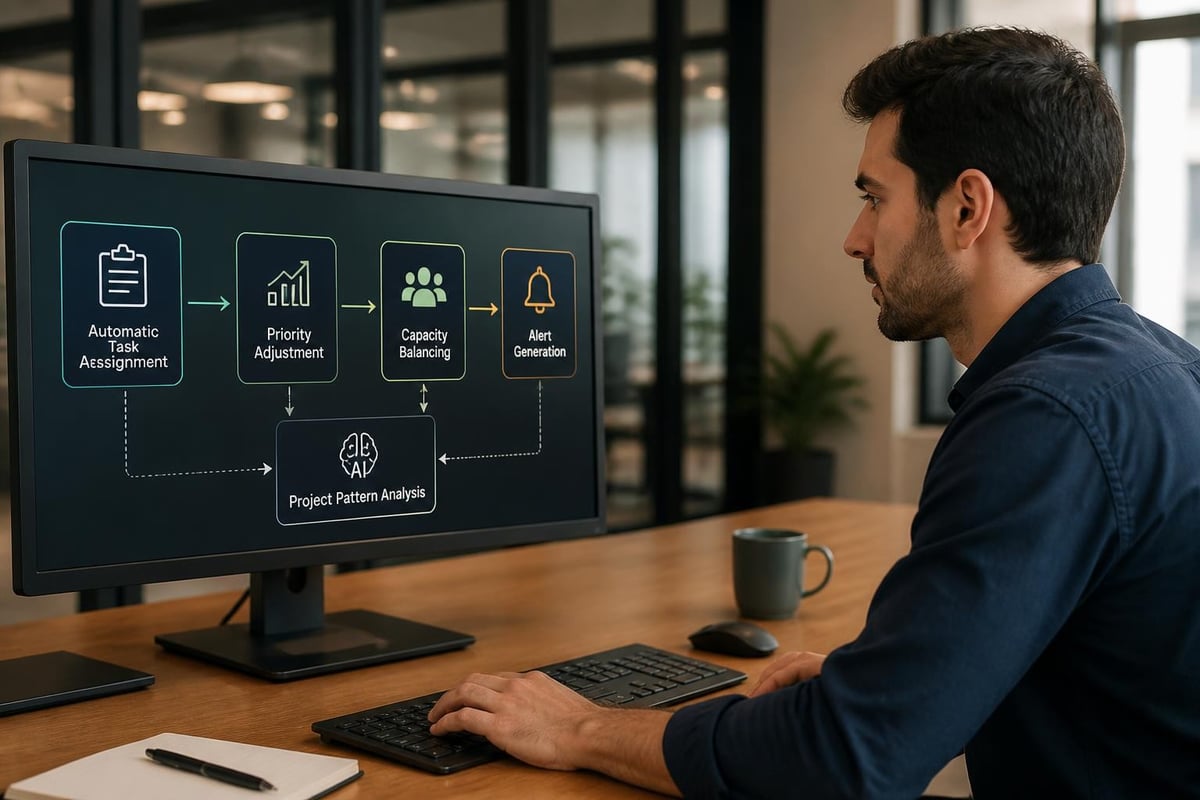
Modern platforms leverage AI to handle routine daily management tasks:
- Automatically flag tasks at risk of missing deadlines based on historical velocity
- Suggest optimal resource allocation when conflicts emerge
- Generate draft status updates from activity logs
- Route service requests to appropriate team members based on expertise and availability
- Predict project health trajectories based on current trends
These capabilities free project managers to focus on judgement, stakeholder management, and problem-solving rather than administrative overhead. An AI service desk can handle routine queries and ticket triaging, ensuring project teams spend their daily energy on high-value activities.
Adapting Daily Management for Different Project Types
Daily project management practices must adapt to the nature of the work. A software development team’s daily rhythm differs substantially from a professional services firm’s client delivery model or a construction project’s coordination needs.
Agile and Sprint-Based Work
Teams following agile methodologies structure their daily project management around sprint commitments and iteration goals. The daily standup becomes the primary coordination mechanism, complemented by continuous integration practices, pair programming sessions, and end-of-day demonstrations of working software.
However, even agile teams must guard against sprint myopia, where daily focus on iteration goals obscures longer-term architectural decisions or technical debt accumulation. Effective daily management in agile contexts balances sprint delivery with strategic technical investments.
Client Services and Billable Work
Professional services teams face unique daily project management challenges around stopping lost billable hours and maintaining visibility across multiple concurrent client engagements. Their daily routines emphasise time capture, client communication, and scope management.
For these teams, daily project management includes:
- Morning review of client priorities and commitments
- Time tracking discipline throughout the day
- Client touchpoints to confirm alignment and surface issues
- End-of-day time reconciliation and tomorrow’s scheduling
- Brief client notes documenting progress and decisions
Platforms designed for professional services integrate time tracking, client management, and project delivery in ways that support rather than interrupt daily workflows.
Internal Initiatives and Change Programs
Internal projects, such as system implementations, process improvements, or organisational change initiatives, require daily management that navigates competing priorities with operational responsibilities. Team members typically contribute to these projects alongside their regular duties, making daily coordination and focus protection critical.
Daily management for internal initiatives emphasises clear, time-boxed commitments that respect people’s other obligations whilst maintaining momentum. Brief daily check-ins replace lengthy meetings, and visual boards keep progress transparent to stakeholders who lack time for detailed status reports.
Metrics That Matter in Daily Project Management
What gets measured gets managed, but measuring the wrong things drives counterproductive behaviours. Effective daily project management focuses on metrics that reveal project health and enable timely intervention.
Leading vs. Lagging Indicators
The most valuable daily metrics predict future outcomes rather than merely reporting past events. A project manager who learns on Friday that the team missed this week’s milestone can do nothing about that week’s outcome. A manager who sees on Tuesday that task completion rates have dropped 30% can investigate and intervene before the week’s milestone is missed.
Powerful leading indicators for daily tracking:
- Task start adherence (percentage of tasks starting when planned)
- Average blocker resolution time
- Quality review pass rates
- Resource allocation vs. capacity
- Stakeholder response times on critical decisions
These metrics require daily or even hourly updates to provide actionable insight. Good project management is really about reducing uncertainty, and leading indicators reduce uncertainty by revealing trajectories early.
Balancing Productivity and Wellbeing Metrics
Daily project management that optimises solely for output creates burnout and turnover. Sustainable high performance requires monitoring team wellbeing alongside delivery metrics.
Simple daily wellbeing indicators include:
- Overtime hours worked
- Weekend or evening work frequency
- Unplanned urgent requests disrupting planned work
- Team member availability for planned collaboration
- Reported stress or concern levels (via brief pulse surveys)
Teams that track these metrics alongside delivery indicators make better decisions about scope, timelines, and resource allocation. A project technically “on schedule” but requiring consistent 60-hour weeks from the team is heading toward failure, just with a delayed impact.
Communication Rhythms for Effective Daily Management
Project success depends as much on communication patterns as on technical execution. Daily project management establishes communication rhythms that keep stakeholders informed without drowning teams in meetings and status requests.
Stakeholder Updates and Reporting
Different stakeholders require different communication frequencies and formats. Executive sponsors typically need brief weekly summaries highlighting progress, decisions needed, and material risks. Direct clients often prefer more frequent updates, sometimes daily, especially during critical phases.
Effective daily project management includes a communication plan that specifies:
| Stakeholder Group | Update Frequency | Preferred Format | Content Focus |
|---|---|---|---|
| Executive sponsor | Weekly | Dashboard + bullet summary | Milestones, budget, risks |
| Project steering committee | Bi-weekly | Slide deck | Strategic decisions, scope changes |
| Direct client | 2-3x weekly | Email or portal update | Deliverables, upcoming activities |
| Extended team | Daily | Team chat or standup | Coordination, blockers, wins |
Automated reporting capabilities reduce the overhead of maintaining these different communication streams. When status updates generate automatically from actual work activity rather than requiring manual compilation, daily project management becomes more sustainable.
Asynchronous Communication for Distributed Teams
Global teams cannot rely solely on synchronous meetings for daily coordination. They require asynchronous communication practices that enable progress across time zones without demanding unsustainable working hours.
Asynchronous daily management practices include:
- Detailed written updates that capture context and rationale
- Video recordings of complex explanations or demonstrations
- Shared documentation that serves as the source of truth
- Clear protocols for what constitutes urgent (requiring immediate response) vs. important (requiring thoughtful response)
- Explicit handoff rituals at time zone boundaries
These practices demand greater communication discipline but unlock the productivity advantages of distributed teams working across multiple shifts.
Continuous Improvement in Daily Practices
Daily project management itself requires ongoing refinement. Teams should periodically review their daily routines, identifying what’s working and what’s creating friction without adding value.
Retrospectives on Daily Practices
Beyond sprint or project retrospectives, high-performing teams occasionally reflect specifically on their daily management practices. Simple questions reveal improvement opportunities:
- Which daily meetings or check-ins consistently deliver value?
- Where do we repeatedly encounter the same frustrations?
- What information do we wish we had earlier each day?
- Which tools or processes slow us down unnecessarily?
- What would make our daily handoffs more effective?
These reflections often reveal that certain meetings have outlived their usefulness or that manual processes could be automated, freeing time for higher-value activities.
Experimenting With New Approaches
Daily project management benefits from controlled experimentation. Teams might trial a new standup format for two weeks, test different time-blocking strategies, or pilot new collaboration tools with a subset of projects before broader adoption.
The key is treating these as genuine experiments with clear success criteria and defined evaluation points, rather than permanent changes implemented on a whim. This experimental mindset, borrowed from product development, accelerates learning and prevents entrenchment of suboptimal practices.
Mastering daily project management separates teams that consistently deliver from those who lurch between crises and missed deadlines. The practices outlined here-structured routines, real-time monitoring, effective handoffs, and continuous improvement-create sustainable high performance without burnout. Chronodesk provides the comprehensive platform professional teams need to implement these daily management practices at scale, uniting project delivery, client management, service desk support, and time tracking in a single structured environment that supports rather than interrupts productive work.