

Professional teams face a persistent challenge: scaling operations without sacrificing quality or burning out staff. The solution lies not in working harder but in creating processes that transform ad-hoc firefighting into predictable, repeatable workflows. When teams move from reactive chaos to structured execution, they unlock capacity, reduce errors, and deliver consistent results that build client confidence and team morale.
Why Creating Processes Matters for Professional Services
Modern professional teams juggle multiple competing priorities: client deliverables, internal projects, service requests, and strategic initiatives. Without documented processes, every task becomes a unique challenge that demands fresh problem-solving energy.
The cost of process absence manifests in several ways:
- Team members waste hours reinventing solutions to recurring problems
- Knowledge remains trapped in individual heads, creating single points of failure
- Onboarding new staff takes months rather than weeks
- Quality varies wildly depending on who handles the work
- Managers spend excessive time answering “how do I” questions
Creating processes addresses these pain points systematically. Rather than treating each project as a unique snowflake, teams develop frameworks that capture institutional knowledge and make it accessible to everyone. This shift from individual heroics to collective capability defines the difference between businesses that struggle to scale and those that grow sustainably.
Research from Harvard Business Review demonstrates that creating reliable operational systems rather than one-off fixes separates consistently growing companies from their stagnant competitors.

Foundation Elements: What Makes Effective Processes
Not all processes deliver equal value. Poorly designed workflows add bureaucracy without benefit, frustrating teams and slowing delivery. Effective processes share common characteristics that balance structure with flexibility.
Clarity and Accessibility
Every process must answer three fundamental questions: when should this process be used, who is responsible for each step, and what constitutes successful completion? Ambiguity breeds inconsistency. Teams need documentation written in plain language, stored where people actually work, and structured to support quick reference during execution.
Modern platforms like Chronodesk embed process guidance directly into work contexts, eliminating the need to hunt through separate wiki pages or outdated PDF manuals.
Appropriate Granularity
The level of detail matters enormously. Over-specified processes create rigid bureaucracy that stifles initiative and innovation. Under-specified processes fail to provide meaningful guidance. The sweet spot varies by context.
| Process Type | Recommended Detail Level | Example |
|---|---|---|
| High-risk, high-compliance | Explicit step-by-step instructions | Financial reporting, security incident response |
| Creative or strategic | Guiding principles with checkpoints | Business development, product strategy |
| Routine operational | Checklists with decision trees | Client onboarding, service request triage |
Consider your team’s experience level when calibrating detail. Junior staff benefit from explicit guidance, while experienced professionals need frameworks that support judgment rather than replace it.
Built-in Improvement Loops
Creating processes is never a one-and-done exercise. Markets shift, technology evolves, and teams discover better approaches through daily execution. Static processes become obsolete liabilities.
Build regular review cycles into your operating rhythm. Quarterly retrospectives asking “which processes helped us this quarter and which held us back” surface opportunities for refinement. Assign process ownership to specific individuals who champion continuous improvement.
Practical Frameworks for Creating Processes
Several established methodologies provide structured approaches to process design. Understanding these frameworks helps teams select appropriate tools for different situations.
Value Stream Mapping for Visibility
Value stream mapping originated in lean manufacturing but translates beautifully to knowledge work. The technique visualizes how work flows through your organization, highlighting value-adding activities versus waste.
The mapping exercise unfolds in five phases:
- Select a specific workflow to analyze (e.g., from client request to delivered project)
- Document the current state by walking through actual work and recording every handoff, wait state, and decision point
- Measure flow metrics including cycle time, touch time, and queue depths
- Design the future state by eliminating waste, reducing handoffs, and automating repetitive steps
- Create an implementation plan with clear owners and deadlines
The Lean Enterprise Institute provides detailed guidance on extracting maximum value from value stream mapping exercises. This approach works particularly well when teams suspect inefficiency but lack concrete data about where time disappears.
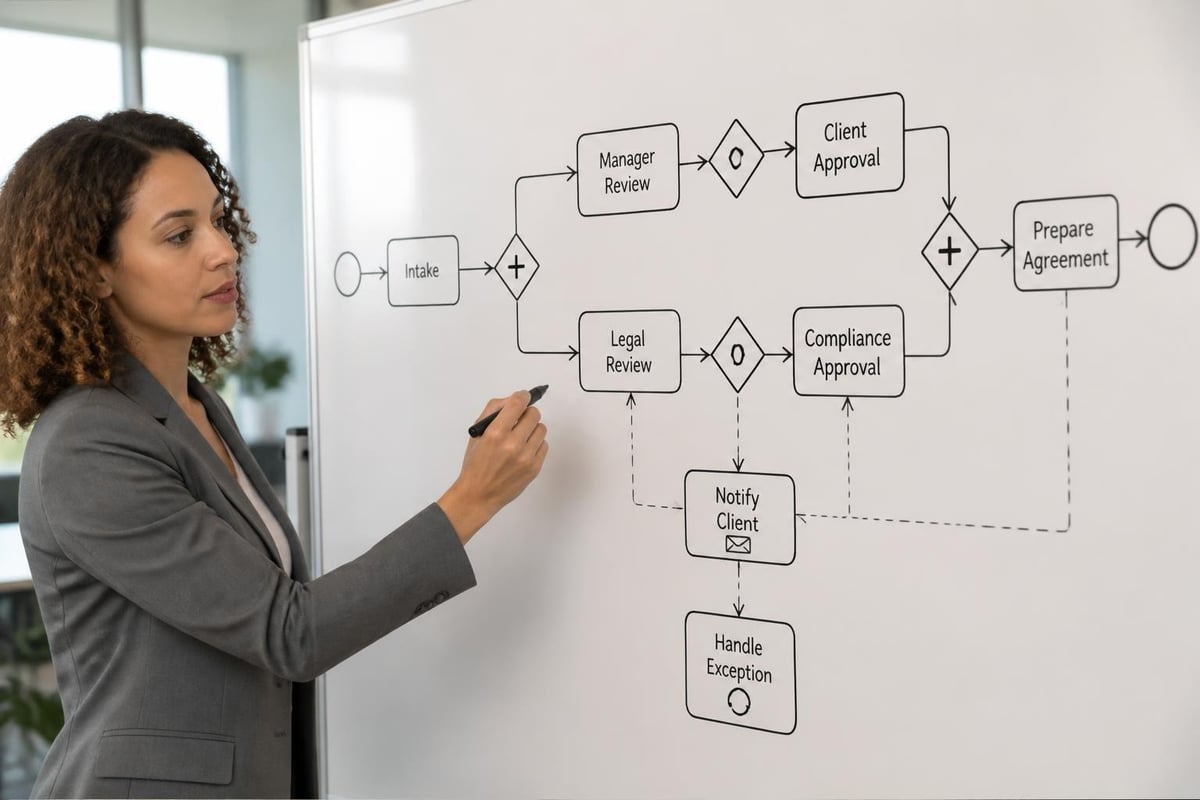
BPMN for Formal Documentation
Business Process Model and Notation provides a standardized visual language for documenting workflows. Unlike ad-hoc flowcharts that vary between creators, BPMN specification defines precise symbols for tasks, gateways, events, and flows that communicate unambiguously across teams and tools.
BPMN shines when creating processes that span departments or integrate with automated systems. The notation supports sufficient complexity to capture real-world nuance while remaining accessible to non-technical stakeholders. Many work management platforms support BPMN import, allowing teams to model processes visually before implementing them in production systems.
For professional services teams managing complex project workflows, BPMN provides the rigour needed to orchestrate multiple workstreams without drowning in confusion.
Agile Process Evolution
Teams working in rapidly changing environments benefit from iterative process development. Rather than designing comprehensive workflows upfront, this approach starts with minimal viable processes and evolves them through feedback cycles.
Begin by documenting the simplest possible version of a workflow: the happy path with no exceptions. Deploy it for a sprint or month, collect feedback, and enhance based on observed gaps. This evolutionary approach reduces upfront investment and ensures processes address real problems rather than hypothetical scenarios.
Implementation Strategy: From Design to Adoption
Creating processes on paper accomplishes nothing if teams ignore them in practice. Successful implementation requires attention to change management and system integration.
Secure Stakeholder Buy-In
Process adoption fails when imposed top-down without consultation. Involve the people who will execute workflows in design sessions. Their frontline experience surfaces constraints and opportunities that managers miss from their removed vantage point.
Frame processes as tools that make work easier rather than controls that restrict autonomy. When team members understand how standardization frees them from repetitive decision-making and reduces errors, resistance transforms into enthusiasm.
Prosci’s change management methodology offers practical frameworks for managing the people side of process transformation, ensuring new ways of working stick rather than fading after initial enthusiasm wanes.
Integrate Processes Into Daily Tools
Documentation living in separate systems from actual work creates friction that guarantees abandonment. Modern work platforms embed process guidance directly into execution contexts.
Consider a service desk scenario. Rather than documenting triage procedures in a wiki that technicians must remember to consult, platforms like Chronodesk’s AI service desk surface relevant guidance automatically based on ticket characteristics, ensuring processes support work rather than interrupting it.
This integration extends to automation opportunities. Many routine process steps can execute automatically based on triggers and conditions, freeing human attention for judgment-requiring activities. Teams using software development workflows benefit enormously from automating status updates, notifications, and hand-offs between development, review, and deployment stages.
Measure Process Performance
What gets measured gets managed. Define clear metrics that indicate whether processes deliver intended value. These typically fall into three categories:
| Metric Category | Example Indicators | What It Reveals |
|---|---|---|
| Efficiency | Cycle time, touches per transaction, automation rate | Whether processes eliminate waste |
| Quality | Error rate, rework percentage, SLA compliance | Whether processes improve outcomes |
| Adoption | Process adherence rate, exception frequency | Whether teams actually follow procedures |
Track these metrics consistently and review trends during retrospectives. Improving numbers validate process investments. Declining metrics signal need for adjustment before problems compound.
For teams managing client commitments, SLA management capabilities that track process performance against service-level agreements provide objective feedback about whether workflows deliver promised results.

Advanced Considerations for Scaling Teams
As organizations grow, process requirements evolve. What works for a ten-person team breaks at fifty and becomes completely inadequate at two hundred. Creating processes that scale requires anticipating future complexity.
Balancing Consistency with Flexibility
Enterprise-scale teams serve diverse client types across multiple service lines. Rigid standardization breaks down when every engagement demands customization. The solution lies in modular process architecture.
Define core procedures that apply universally: how projects get initiated, how time gets tracked, how invoicing occurs. Then create optional process modules for specific contexts: different approval chains for different client tiers, specialized workflows for particular service types, custom reporting for specific industries.
This modular approach maintains operational consistency where it matters while preserving flexibility where situations demand it. Teams avoid both the chaos of complete customization and the brittleness of one-size-fits-all mandates.
Process Governance and Ownership
Distributed teams need clear accountability for process stewardship. Assign each major workflow to a specific owner responsible for keeping documentation current, gathering feedback, and proposing improvements.
Create a lightweight governance forum that reviews process change requests quarterly. This prevents fragmentation while enabling evolution. Without governance, processes either ossify into outdated rituals or fragment into incompatible variants across teams.
Technical Process Automation
Technical teams increasingly apply DevOps principles to operational processes, treating workflow automation as code that can be versioned, tested, and deployed systematically. The NIST guidance on secure CI/CD pipelines provides a framework for teams automating complex technical workflows with appropriate security controls.
This infrastructure-as-code approach to creating processes offers powerful advantages: changes can be proposed, reviewed, and deployed through standard development workflows. Teams gain the ability to test process modifications in staging environments before production deployment, dramatically reducing the risk of workflow disruptions.
Common Pitfalls and How to Avoid Them
Even well-intentioned process initiatives encounter predictable obstacles. Recognizing these patterns helps teams navigate around them.
Over-Engineering Early Stages
The temptation to design comprehensive processes upfront before validating them against reality leads to waste. Teams invest months documenting workflows only to discover their assumptions about how work actually flows were incorrect.
Start small. Document one critical workflow end-to-end, implement it, gather feedback, and refine. Build confidence and capability through quick wins before tackling more complex processes.
Neglecting the Human Element
Creating processes often focuses excessively on logical workflow design while underestimating psychological and cultural factors. People resist change, particularly when new procedures threaten established routines or perceived status.
Address emotional responses directly. Acknowledge that change creates discomfort. Provide training and support during transitions. Celebrate early adopters. These human-centred interventions often matter more than technical process quality for determining adoption success.
Treating Documentation as the Destination
Writing process documentation feels productive, but documentation divorced from execution delivers zero value. The real work lies in embedding processes into daily operations until they become habitual.
Schedule regular check-ins during initial rollout periods. Observe whether teams actually follow new procedures. When they don’t, investigate why: is the process unclear, impractical, or solving the wrong problem? Iterate based on observed behaviour rather than assumed compliance.
Ignoring Process Interactions
Workflows rarely exist in isolation. A change to client onboarding impacts project setup, resource allocation, and billing procedures. Teams optimizing individual processes without considering system-level interactions risk sub-optimizing the whole.
Map dependencies between major workflows. When designing changes, trace downstream impacts. This systems thinking prevents improvements in one area from creating problems elsewhere.
For organizations seeking to streamline IT business processes, understanding how service desk operations intersect with project delivery and client relationship management ensures coherent rather than fragmented improvements.
Process Technology: Choosing the Right Platform
Creating processes requires tools that support documentation, execution, and continuous improvement. The technology landscape offers numerous options with varying strengths.
Core Platform Capabilities
Effective process platforms provide several essential capabilities:
- Workflow automation that executes routine steps without manual intervention
- Role-based access ensuring the right people see relevant information
- Audit trails documenting who did what when for compliance and learning
- Integration APIs connecting processes across your technology stack
- Analytics dashboards revealing bottlenecks and performance trends
Platforms designed specifically for professional services delivery, rather than generic task managers, understand the unique requirements of client work. They handle complexities like time tracking, billing integration, and client communication that general-purpose tools struggle with.
When evaluating alternatives, teams often find that specialized professional services platforms deliver dramatically better fit than adapting consumer-focused collaboration tools to business contexts.
Integration Architecture
No single platform handles every business function. Your process technology must integrate cleanly with existing tools for accounting, communication, CRM, and development.
Evaluate integration options carefully. Native built-in connections offer the most reliable experience. Platforms exposing comprehensive APIs enable custom integrations when needed. Avoid tools that create information silos, forcing manual data transfer between systems.
The true cost of platform fragmentation extends beyond licensing fees. Tool overload fragments attention, creates version control nightmares, and generates reconciliation overhead that erodes the efficiency gains processes promise.
Balancing Power and Usability
Enterprise platforms often prioritize configurability over usability, requiring dedicated administrators to manage. Conversely, simple tools lack the sophistication needed for complex professional services workflows.
Seek the middle ground: platforms powerful enough to handle your actual complexity but approachable enough that team members adopt them without extensive training. Test usability with actual users during evaluation. Beautiful demos shown by skilled sales engineers reveal little about day-to-day user experience.
Creating processes transforms how professional teams work, replacing reactive chaos with systematic capability that scales as organisations grow. The investment in structured workflows pays dividends through reduced errors, faster onboarding, and consistent delivery that builds client confidence. Chronodesk provides professional teams with a comprehensive platform that makes creating processes practical rather than theoretical, embedding workflow guidance directly into daily operations while automating routine steps and providing the analytics needed for continuous improvement.