

Construction projects demand precise coordination across dozens of trades, hundreds of tasks, and countless dependencies. Whether building a commercial tower or renovating a heritage structure, project teams face the challenge of orchestrating complex workflows whilst managing constrained budgets and tight deadlines. Construction scheduling software has evolved from simple Gantt charts into sophisticated platforms that integrate planning, resource management, and real-time collaboration, fundamentally transforming how the industry delivers projects.
The Evolution of Construction Scheduling Technology
Traditional construction planning relied on paper-based schedules, manual calculations, and static milestone tracking. Project managers spent hours updating schedules by hand, only to see them become obsolete within days as site conditions changed.
Modern construction scheduling software represents a quantum leap in capabilities. These platforms now incorporate critical path methodology, resource levelling, and constraint-based planning into unified systems that adapt dynamically to project realities. The shift mirrors broader digital transformation efforts, with digital twin technologies and IoT integration creating new possibilities for real-time schedule control and predictive analytics.
Key Capabilities That Define Modern Systems
Today’s construction scheduling software delivers far more than timeline visualisation:
- Critical path analysis that automatically identifies schedule-driving activities
- Resource allocation tools that balance labour, equipment, and material availability
- Constraint management for sequencing trade activities and managing dependencies
- Look-ahead scheduling that enables proactive planning and conflict resolution
- Real-time updates reflecting actual site progress and emerging conditions
- Multi-project visibility for portfolio management across concurrent builds
The integration of these capabilities creates a comprehensive planning environment that supports both strategic project management and tactical daily coordination.
Understanding Critical Path and Dependencies
The critical path method remains the foundation of construction scheduling software, identifying the sequence of activities that directly determines project duration. Any delay along this path pushes back completion, making it the focus of intense management attention.
Construction projects typically involve thousands of activities with complex logical relationships:
| Dependency Type | Description | Common Application |
|---|---|---|
| Finish-to-Start | Successor begins when predecessor completes | Concrete curing before formwork removal |
| Start-to-Start | Activities begin simultaneously | Parallel trade installations |
| Finish-to-Finish | Activities complete together | Coordinated system testing |
| Start-to-Finish | Rare in construction | Phased handovers |
Understanding these relationships proves essential for accurate scheduling. Software algorithms calculate float (schedule flexibility) for each activity, revealing which tasks can shift without impacting completion and which demand unwavering focus. This analytical capability transforms scheduling from guesswork into data-driven decision-making, much like how good project management reduces uncertainty through structured planning processes.
Resource Levelling and Optimisation
Beyond sequencing activities, construction scheduling software must allocate finite resources across competing demands. A project might have sufficient total labour hours, but resource levelling prevents overallocation by distributing work across available capacity.
Modern platforms analyse resource histograms, identifying peaks and valleys in demand. They can automatically smooth workloads, extend non-critical activities to reduce peak requirements, or flag situations requiring additional crew allocation. This optimisation ensures realistic schedules that reflect actual resource availability rather than theoretical timelines.
Integration With Building Information Modelling
The convergence of construction scheduling software with Building Information Modelling (BIM) has created powerful 4D planning capabilities. By linking schedule activities to 3D model elements, teams visualise construction sequences spatially, identifying clashes and coordination issues before they arise on site.
Industry standards for openBIM integration enable seamless data exchange between scheduling platforms and modelling software. This interoperability ensures schedule updates reflect design changes automatically, whilst model modifications trigger schedule revisions.
Four-Dimensional and Five-Dimensional Planning
4D scheduling adds the time dimension to 3D models, creating animated construction sequences that:
- Reveal spatial conflicts between trades working in proximity
- Validate material delivery timing against installation schedules
- Communicate construction methodology to stakeholders visually
- Support site logistics planning for equipment and laydown areas
5D scheduling extends this further by incorporating cost data. Teams can track budget consumption against schedule progress, identify cost impacts of delays, and evaluate acceleration scenarios. Recent research into integrated 4D/5D digital twin frameworks demonstrates how AI and reality capture technologies enable probabilistic schedule control and automated updates based on site conditions.
Lean Construction and Last Planner System Integration
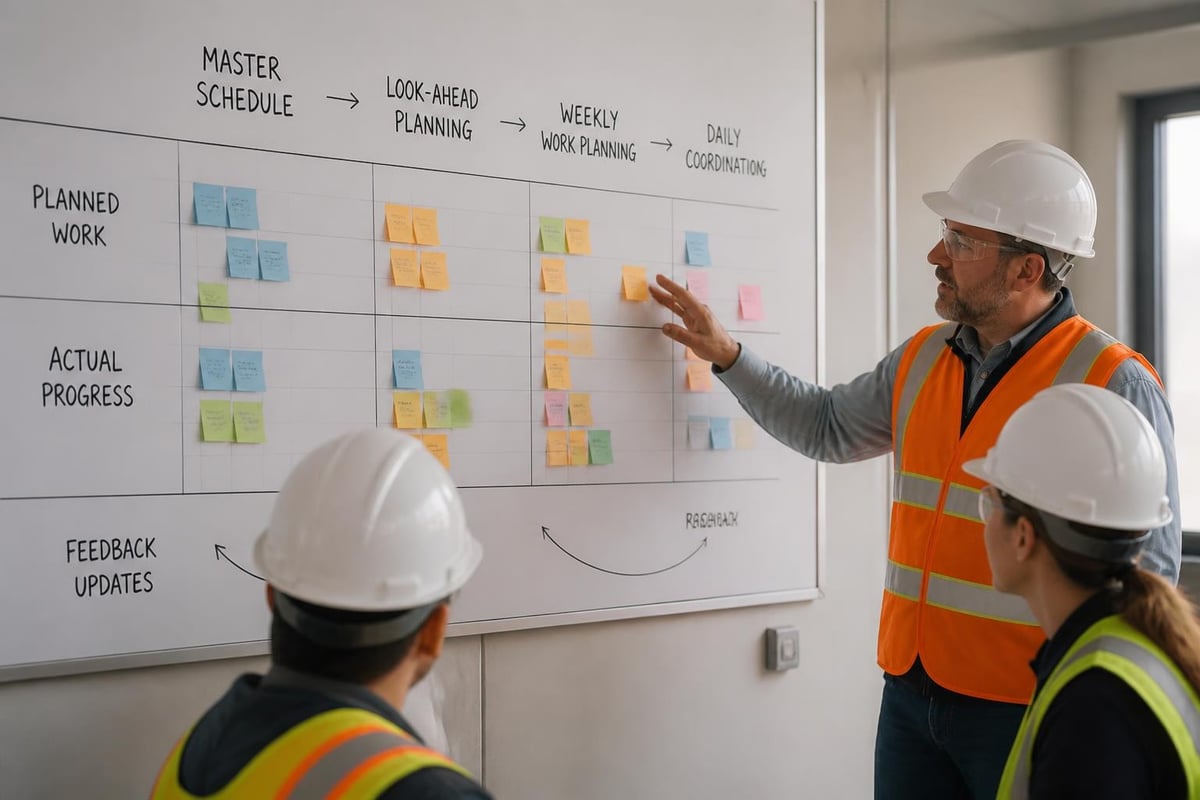
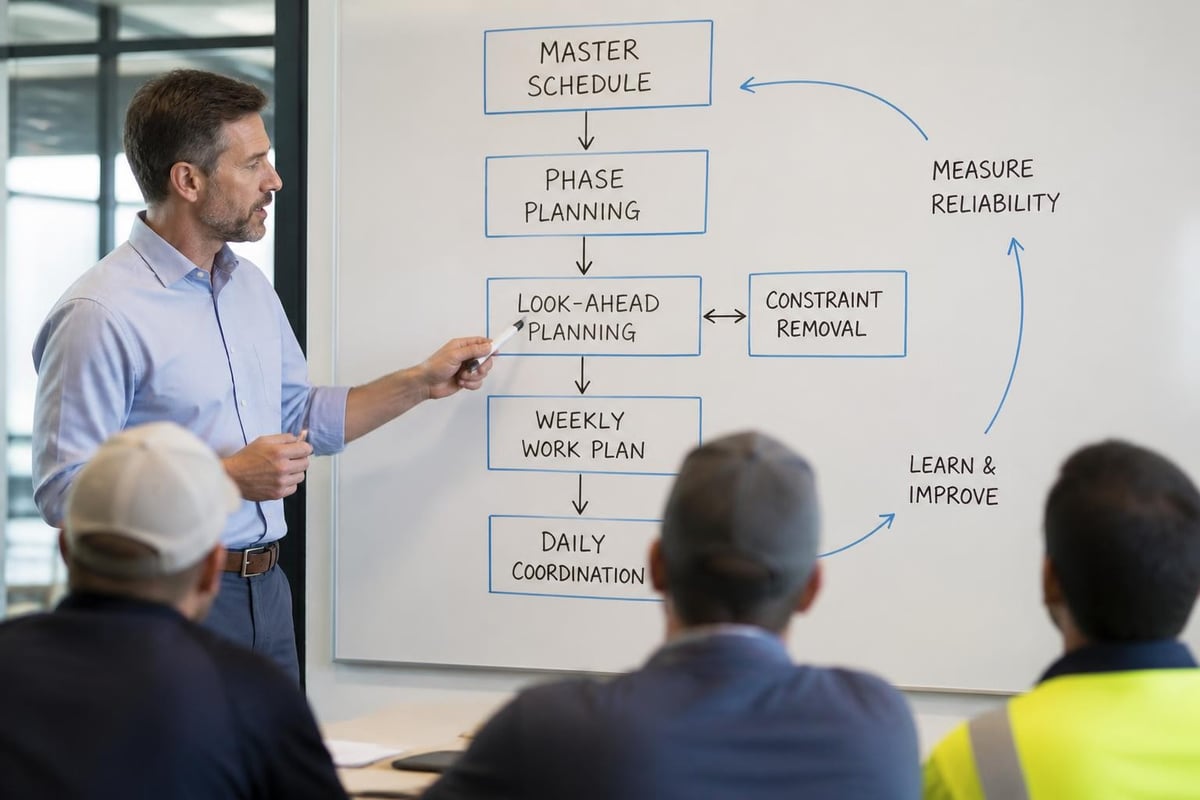
Construction scheduling software increasingly incorporates Lean principles, particularly the Last Planner System (LPS), which emphasises collaborative planning and reliable commitment-making. Traditional critical path scheduling focuses on “should” dates; Lean approaches add “can” and “will” criteria.
The LPS framework operates at multiple planning horizons:
- Master schedule defining major milestones and phases
- Phase planning engaging trade partners in detailed sequencing
- Look-ahead planning identifying and removing constraints 3-6 weeks ahead
- Weekly work planning securing reliable commitments from trade crews
- Daily huddles coordinating immediate activities and resolving issues
Software platforms supporting these workflows enable constraint tracking, commitment reliability measurement, and reasons-for-variance analysis. The Lean Construction Institute provides detailed guidance on implementing these approaches alongside scheduling systems, including Takt time planning for repetitive work.
Measuring Plan Reliability
Lean-enabled construction scheduling software tracks Percent Plan Complete (PPC), measuring how reliably teams accomplish committed work. This metric reveals planning quality and constraint management effectiveness, driving continuous improvement in the planning process itself.
Mobile Access and Field Coordination
Construction happens on site, not in offices. Modern construction scheduling software provides mobile applications that bring schedules to field teams, enabling real-time progress updates and issue documentation.
Superintendents and foremen can:
- View daily work plans filtered to their crews and areas
- Update activity status marking tasks complete or reporting delays
- Document constraints photographing site conditions causing delays
- Access drawings and specifications linked to scheduled activities
- Communicate changes to downstream trades affected by variances
This field connectivity closes the loop between planning and execution, ensuring schedules reflect actual site conditions rather than outdated assumptions. The real-time visibility mirrors broader platform integration trends, as explored in discussions about how business platforms should communicate with each other.
Enterprise Features for General Contractors
Large construction firms managing multiple concurrent projects require enterprise capabilities beyond single-project scheduling. Construction scheduling software for these organisations must support:
Portfolio Management and Resource Sharing
General contractors need visibility across all active projects to allocate resources strategically. Enterprise platforms provide portfolio dashboards showing schedule health, resource utilisation, and milestone risks across the entire project portfolio.
Shared resource pools enable optimisation across projects. When one build experiences delays creating resource availability, the system can alert schedulers to opportunities on other sites. This enterprise-wide perspective maximises resource productivity whilst maintaining schedule commitments.
| Enterprise Capability | Business Value | Implementation Consideration |
|---|---|---|
| Multi-project dashboards | Executive visibility and control | Requires standardised work breakdown structures |
| Shared resource pools | Optimised utilisation across portfolio | Needs robust allocation approval workflows |
| Template libraries | Consistent estimating and planning | Must allow customisation for project types |
| Role-based permissions | Data security and collaboration | Should support external partner access |
| Centralised reporting | Performance tracking and lessons learned | Demands data governance standards |
Integration With Financial Systems
Enterprise construction scheduling software connects to ERP and accounting platforms, enabling sophisticated earned value analysis. By comparing scheduled value, earned value, and actual costs, project controls teams identify performance trends early.
This integration supports accurate forecasting of final costs and completion dates, essential for portfolio planning and client communication. The financial visibility also enables better resource allocation decisions, prioritising attention on projects with the greatest variance or risk.
Subcontractor Collaboration and Access
Construction relies on specialist subcontractors who bring deep trade expertise but operate as independent businesses. Construction scheduling software must facilitate collaboration whilst respecting organisational boundaries.
Modern platforms provide:
- Limited-access portals where subcontractors view relevant schedule segments
- Mobile applications for trade crews to update progress from site
- Commitment tracking recording promises made during planning meetings
- Constraint documentation enabling subs to flag impediments early
- Look-ahead visibility showing upcoming work requiring preparation
This collaborative environment distributes planning responsibility to those executing the work, improving accuracy and buy-in. The approach recognises that effective scheduling depends on engagement from all project participants, not just the general contractor’s team.
Managing External Partner Relationships
Granting external parties system access requires careful permission management. Construction scheduling software should enable granular controls limiting subcontractors to relevant projects, buildings, or zones whilst preventing visibility into commercial information like rates or margins.
These controls parallel broader considerations in enterprise work management platforms, where secure collaboration with external partners demands sophisticated access management.

Weather and Site Condition Management
Unlike office work, construction productivity depends heavily on weather and site conditions. Rain stops concrete pours, high winds prevent crane operations, and extreme temperatures affect curing times and worker safety.
Advanced construction scheduling software incorporates weather forecasting, automatically identifying at-risk activities and suggesting protective measures. When weather events occur, the system models their impact across dependent activities, providing updated completion forecasts.
Site condition tracking extends this concept to other variables:
- Material delivery status affecting installation schedules
- Inspection availability determining activity sequencing
- Equipment breakdowns requiring schedule adjustments
- Design clarification delays impacting dependent work
By systematically tracking these factors, construction scheduling software moves beyond simple timeline tracking to become a comprehensive project control system.
Change Management and Version Control
Construction projects evolve constantly as designs develop, owners modify requirements, and site conditions reveal unexpected challenges. Construction scheduling software must manage this change rigorously whilst maintaining schedule integrity.
Robust platforms provide:
- Baseline preservation maintaining original approved schedules for comparison
- Version control tracking schedule revisions with timestamps and authors
- Impact analysis showing how proposed changes affect completion and costs
- Approval workflows routing significant changes through stakeholder review
- Audit trails documenting decision history for dispute resolution
This change management discipline ensures teams understand schedule evolution and can demonstrate how external factors rather than poor planning caused delays. The documentation proves invaluable during claims and litigation.
Reporting and Stakeholder Communication
Construction scheduling software generates extensive reporting for diverse audiences:
| Report Type | Primary Audience | Key Information |
|---|---|---|
| Executive dashboard | Owner, senior leadership | Milestone dates, budget status, major risks |
| Look-ahead schedule | Superintendents, trade foremen | Upcoming 3-6 week activities, constraints |
| Critical path analysis | Project managers | Schedule-driving activities, float consumption |
| Resource histograms | Resource managers | Labour and equipment demand over time |
| Variance analysis | Project controls | Planned vs. actual progress, trend forecasting |
Effective reporting matches information detail and technical sophistication to audience needs. Owners require high-level milestone tracking; field supervisors need detailed daily plans. Modern platforms support customisable reporting templates that automate regular stakeholder communication.
These reporting capabilities address common challenges enterprise teams face when extracting actionable insights from complex project data.
Mobile-First Design for Field Teams
The next generation of construction scheduling software embraces mobile-first design, recognising that most users interact with schedules on tablets and phones at the job site rather than desktop computers in offices.
Mobile-optimised interfaces provide:
- Touch-friendly navigation designed for gloved hands and outdoor conditions
- Offline capability allowing schedule access without cellular connectivity
- Voice input for hands-free progress updates and issue documentation
- Photo integration linking site images to specific activities
- Simplified workflows focused on essential field tasks rather than office planning
This mobile emphasis democratises schedule access, ensuring every trade crew understands daily expectations and can contribute to planning accuracy through timely updates.
Artificial Intelligence and Predictive Analytics
Cutting-edge construction scheduling software now incorporates artificial intelligence to enhance planning accuracy and predict schedule risks. Machine learning algorithms analyse historical project data to:
- Estimate activity durations more accurately than manual assumptions
- Identify high-risk activities likely to experience delays
- Recommend mitigation strategies based on similar past situations
- Forecast completion dates using probabilistic methods rather than deterministic CPM
- Optimise resource allocation balancing utilisation and schedule pressure
These AI capabilities help project teams learn from organisational experience, applying lessons from hundreds of past projects to current planning challenges. The technology represents the forefront of construction management innovation, as detailed in research on probabilistic schedule control using digital twins.
Balancing Automation With Professional Judgement
Whilst AI provides powerful analytical support, construction scheduling remains fundamentally a human activity requiring professional judgement. Software should augment scheduler expertise rather than replace it, flagging anomalies and suggesting alternatives whilst leaving final decisions to experienced planners who understand project nuances.
Selecting Construction Scheduling Software
Choosing the right platform requires evaluating numerous factors across technical capabilities, user experience, and business considerations:
Core scheduling functionality:
- Critical path calculation accuracy and speed
- Constraint types and relationship flexibility
- Resource allocation and levelling capabilities
- Calendar management for various crew schedules
Integration ecosystem:
- BIM platform connectivity for 4D/5D planning
- ERP system integration for financial tracking
- Document management system links
- Mobile application quality and offline capability
User experience:
- Learning curve for schedulers and field users
- Interface intuitiveness and customisation options
- Reporting flexibility and stakeholder communication tools
- Support quality and training resources
Business considerations:
- Licensing model (per user, per project, enterprise)
- Implementation services and change management support
- Vendor stability and product roadmap
- Data security and compliance certifications
For organisations managing construction alongside other project types, considering platforms that handle diverse professional services work may provide broader value than construction-specific tools.
Common Implementation Challenges
Even excellent construction scheduling software fails to deliver value if poorly implemented. Common pitfalls include:
Insufficient training investment leading to underutilisation of advanced features. Field teams default to paper lists when they don’t understand mobile applications. Schedulers create overly simplified plans that miss critical dependencies. Comprehensive training programmes addressing different user roles prove essential.
Lack of standardisation across projects within the same organisation. Without consistent work breakdown structures and activity coding, portfolio reporting becomes impossible. Template development and governance processes ensure consistency whilst allowing project-specific adaptation.
Poor data discipline undermining schedule accuracy. Irregular updates, incomplete constraint documentation, and failure to maintain baselines render schedules useless. Establishing clear ownership, update protocols, and quality standards maintains schedule integrity.
Resistance from field teams who view scheduling as administrative overhead rather than operational support. Demonstrating value through look-ahead planning that removes constraints and enables productive work builds buy-in. The software should solve field problems, not create bureaucracy.
The Future of Construction Scheduling
Construction scheduling software continues evolving rapidly, with several emerging trends shaping the next generation of platforms:
Reality capture integration using drones, laser scanning, and photogrammetry to automatically update schedules based on site progress. Computer vision algorithms compare as-built conditions to scheduled activities, flagging variances and updating completion percentages.
Blockchain for supply chain visibility providing immutable records of material fabrication, shipping, and delivery. Smart contracts automatically trigger schedule updates when milestones occur, improving coordination with off-site manufacturing.
Augmented reality interfaces overlaying schedule information onto physical site views. Field teams wearing AR glasses see which activities should be occurring in specific locations, access relevant drawings instantly, and document issues in spatial context.
Generative design for schedule optimisation using algorithms to evaluate thousands of potential construction sequences, identifying optimal approaches based on multiple constraints and objectives. This computational power helps teams discover non-obvious sequencing strategies that reduce duration or cost.
These technologies promise to make construction scheduling software more accurate, responsive, and valuable as a project control tool.
Construction scheduling software has transformed from basic timeline tracking into sophisticated platforms that integrate planning, resource management, and real-time coordination across complex projects. The most effective implementations balance powerful analytical capabilities with practical usability for field teams. Whether you’re managing construction projects, professional services engagements, or operational workflows, Chronodesk provides the comprehensive work platform to coordinate projects, resources, and delivery in one structured environment designed for professional teams.