

When enterprise teams struggle to align projects with strategic objectives, resource conflicts multiply and portfolio value diminishes. Clarity software for project management has emerged as a solution for organisations seeking to elevate their project portfolio management (PPM) capabilities from tactical task tracking to strategic decision-making. This enterprise-grade platform addresses the complexity of managing multiple concurrent initiatives whilst maintaining visibility into resource utilisation, financial performance, and strategic alignment across the entire portfolio.
Understanding Clarity Software in the Enterprise Context
Clarity software for project management, formerly known as CA Clarity PPM and now part of Broadcom’s ValueOps portfolio, represents a comprehensive approach to managing project portfolios at scale. Unlike lightweight project tracking tools, this platform focuses on strategic portfolio management (SPM), enabling organisations to make informed decisions about which projects to fund, how to allocate constrained resources, and which initiatives deliver the greatest strategic value.
The distinction between project management and portfolio management becomes critical at enterprise scale. Individual project success means little if the wrong projects receive funding. According to Broadcom’s 2026 Strategic Portfolio Management report, organisations increasingly recognise that strategic alignment and portfolio optimisation drive more value than execution efficiency alone.
Core Capabilities That Define Clarity
Clarity software for project management delivers several foundational capabilities that differentiate it from traditional project tools:
- Strategic portfolio planning with investment scenarios and what-if analysis
- Resource capacity planning across people, skills, roles, and departments
- Financial management including budgeting, forecasting, cost tracking, and benefit realisation
- Demand management to capture, evaluate, and prioritise project requests
- Governance workflows for stage-gate processes and approval hierarchies
- Programme and project execution with task management, timesheets, and collaboration
- Reporting and analytics with executive dashboards and portfolio health metrics
These capabilities address the challenge highlighted in many reporting headaches that enterprise teams face: consolidating data from disparate sources whilst maintaining accuracy and timeliness.

Strategic Alignment Through Portfolio Management
The primary value proposition of clarity software for project management centres on strategic alignment. Organisations often fund projects based on political pressure, squeaky-wheel dynamics, or historical precedent rather than strategic contribution. This misalignment wastes resources and dilutes strategic focus.
Investment Planning and Scenario Analysis
Clarity enables portfolio managers to model different investment scenarios before committing resources. Teams can evaluate trade-offs between competing priorities, assess the impact of budget constraints, and optimise portfolios against strategic objectives.
The platform supports multiple prioritisation frameworks, from weighted scoring models to financial metrics like NPV and ROI. PMI’s Standard for Portfolio Management provides foundational guidance on these processes, which Clarity implements through configurable scoring models and automated ranking.
| Prioritisation Approach | Primary Focus | Best For |
|---|---|---|
| Strategic Fit Scoring | Alignment with objectives | Strategy execution |
| Financial Metrics | ROI, NPV, payback period | Capital allocation |
| Risk-Adjusted Value | Expected value × probability | Balanced portfolios |
| Resource Efficiency | Capacity utilisation | Constrained environments |
Modern portfolio decisions increasingly incorporate sustainability and ESG criteria alongside traditional financial metrics. Recent PMI research on embedding sustainability demonstrates how organisations integrate these factors into portfolio selection processes that platforms like Clarity support through custom scoring dimensions.
Governance and Stage-Gate Processes
Clarity software for project management enforces governance through configurable stage-gate workflows. Projects progress through defined phases (initiation, planning, execution, closure) with formal decision points where stakeholders review progress, assess continued viability, and authorise additional funding.
This structure prevents runaway projects from consuming resources indefinitely. It forces regular reassessment of strategic fit and provides natural exit points for initiatives that no longer deliver value.
Resource Management at Enterprise Scale
Perhaps no challenge vexes enterprise teams more than resource management across multiple concurrent projects. Clarity software for project management tackles this through comprehensive capacity planning and allocation capabilities.
Capacity Planning and Demand Forecasting
The platform maintains a central resource pool where managers define people, roles, skills, and organisational units. Resource managers can view capacity across time periods, identify bottlenecks, and forecast demand based on planned and proposed projects.
Key resource management features include:
- Hard and soft booking to distinguish confirmed versus tentative allocations
- Role-based planning for early-stage projects before specific people are assigned
- Skill matching to identify qualified resources for specialised work
- What-if analysis to model different staffing scenarios
- Time tracking integration to measure actual versus planned utilisation
This approach addresses the reality that good project management is really about reducing uncertainty, and resource conflicts represent a major source of project uncertainty.

Addressing Resource Conflicts Systematically
When multiple projects compete for the same resources, clarity software for project management provides data-driven resolution. Portfolio managers can compare project priorities, assess the impact of delaying lower-priority work, and make informed trade-offs.
The platform supports several resource conflict resolution strategies:
- Priority-based allocation where higher-priority projects receive resources first
- Load levelling to smooth resource demand and reduce peaks
- Outsourcing analysis to identify work suitable for external resources
- Timeline adjustment to shift project schedules and eliminate conflicts
- Scope reduction to reduce resource requirements while preserving core value
These capabilities prove especially valuable for professional services teams balancing client commitments against internal capacity constraints.
Financial Control and Investment Optimisation
Beyond resource management, clarity software for project management provides comprehensive financial controls that extend from initial budgeting through benefit realisation tracking.
Budget Management and Cost Control
The platform supports multiple budget types (capital, operational, labour, non-labour) with hierarchical roll-ups from tasks to projects to programmes to portfolios. Finance teams can establish budget controls that prevent overspending, track commitments and actuals, and forecast completion costs.
Financial management capabilities include:
- Multi-currency support for global operations
- Cost plan versions for baseline, forecast, and what-if scenarios
- Benefit tracking to measure realised value against business cases
- Charge-back mechanisms for shared services and internal allocations
- Integration with ERP systems for procurement and accounting
These controls address the challenge many enterprises face with lost billable hours and revenue leakage when project financial data lives in disconnected systems.
Investment Performance and Benefit Realisation
Clarity software for project management extends beyond project delivery to measure whether completed projects actually deliver their promised benefits. Business case assumptions become measurable targets, with accountability for benefit realisation tracking.
This closed-loop approach transforms portfolio management from a one-time selection process into continuous optimisation. Organisations learn which types of projects over-promise, which business units deliver reliably, and how to improve estimation accuracy over time.
Integration Capabilities and Ecosystem Connectivity
Enterprise environments rarely standardise on a single tool. Clarity software for project management must coexist with existing systems, from ERP platforms to collaboration tools to specialised industry applications.
Standard Integration Patterns
The platform provides several integration mechanisms:
- REST APIs for custom integrations and data exchange
- Pre-built connectors for common enterprise systems (SAP, Oracle, Workday)
- Data warehouse integration for consolidated reporting across systems
- Authentication federation via SAML and SSO protocols
- Workflow automation through integration platforms (MuleSoft, Dell Boomi)
According to TechTarget’s analysis of PPM tools, integration capabilities increasingly differentiate enterprise-grade platforms from standalone tools. The ability to exchange data bidirectionally whilst maintaining data integrity proves critical for adoption.
Teams working across multiple platforms face the reality that work platforms should talk to each other rather than creating data silos.
Execution Tool Integration
Whilst clarity software for project management excels at portfolio strategy and resource planning, many organisations use specialised tools for day-to-day execution. Development teams might use Jira for task management, whilst operational teams prefer service desk platforms.
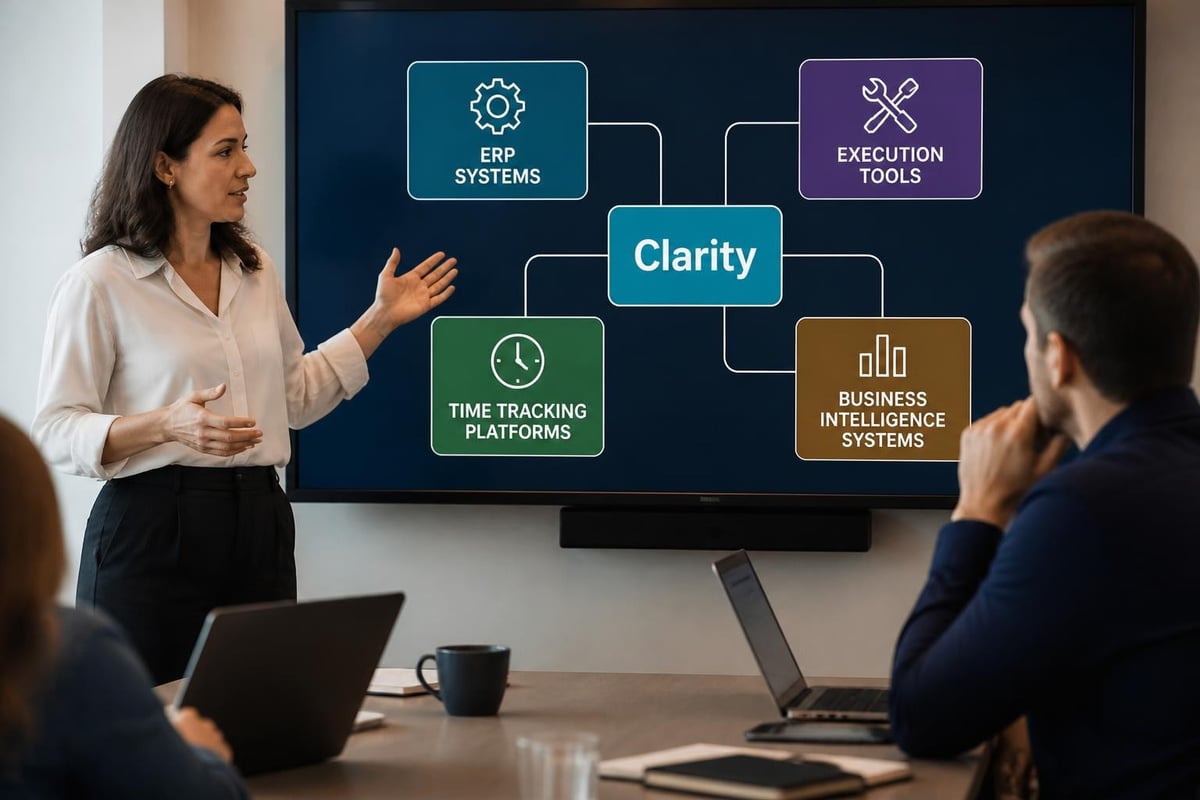
Clarity can integrate with these execution tools, pulling actual progress and timesheet data whilst pushing resource assignments and budget allocations. This bidirectional sync enables teams to work in their preferred tools whilst maintaining portfolio-level visibility and control.
Implementation Considerations and Adoption Challenges
Deploying clarity software for project management represents a significant undertaking. Successful implementations require more than technical configuration-they demand process redesign, organisational change, and sustained executive commitment.
Common Implementation Pitfalls
Organisations frequently encounter these challenges:
- Over-customisation that creates technical debt and upgrade difficulties
- Process complexity where the tool enforces bureaucratic overhead without adding value
- Data quality issues when source systems provide inconsistent or inaccurate information
- Insufficient training leading to low adoption and workarounds
- Misaligned metrics that measure activity rather than outcomes
The SD Times analysis of strategic portfolio management trends highlights that successful SPM adoption requires balancing governance rigour with execution flexibility.
Organisational Change Management
Technical deployment represents only half the battle. Clarity software for project management changes how organisations make decisions about project investments. It shifts power from political negotiations to data-driven portfolio optimisation.
| Change Dimension | Traditional Approach | SPM with Clarity |
|---|---|---|
| Project selection | Politics and relationships | Strategic fit and data |
| Resource allocation | Local optimisation | Portfolio optimisation |
| Performance measurement | On-time, on-budget | Strategic value delivery |
| Decision authority | Distributed and informal | Centralised and transparent |
This shift threatens established power structures and informal processes. Successful implementations require executive sponsorship that reinforces new decision-making norms and holds stakeholders accountable to portfolio-level optimisation rather than local interests.
Advanced Analytics and Portfolio Optimisation
Modern clarity software for project management incorporates advanced analytics capabilities that go beyond standard reporting. These features enable portfolio managers to identify patterns, forecast outcomes, and optimise decisions.
Predictive Analytics and Forecasting
The platform can analyse historical project data to improve estimation accuracy. By examining past projects with similar characteristics, teams can develop more realistic schedules, budgets, and resource plans.
Advanced implementations incorporate machine learning models that predict project risks, identify likely delays, and recommend corrective actions. These predictive capabilities help portfolio managers intervene proactively rather than reacting to problems after they materialise.
Academic research continues advancing portfolio optimisation techniques. The PIT-plot prioritisation framework represents one example of analytical tools that complement traditional scoring models with visual trade-off analysis.
Portfolio Optimisation Algorithms
Clarity software for project management can apply optimisation algorithms to recommend portfolio compositions that maximise strategic value within constraints. These algorithms consider:
- Budget limitations across different funding sources
- Resource capacity constraints by skill and time period
- Dependencies between projects where some enable others
- Risk tolerance and portfolio balance requirements
- Strategic objectives with varying weights and priorities
Harvard Business Review guidance on selecting and prioritising projects emphasises that portfolio decisions require balancing multiple competing criteria rather than optimising a single metric.
Optimisation approaches include:
- Integer programming to select projects from a candidate pool
- Monte Carlo simulation to assess portfolio risk exposure
- Efficient frontier analysis to identify maximum return portfolios
- Sensitivity analysis to understand how assumptions affect recommendations
Alternatives and Market Positioning
Whilst clarity software for project management serves enterprise portfolio needs, organisations should understand the broader landscape of work management tools and when alternative approaches might prove more appropriate.
Enterprise PPM Alternatives
Several platforms compete in the enterprise PPM space, each with different strengths and architectural philosophies. Some organisations prefer cloud-native SaaS solutions, whilst others require on-premises deployments for regulatory or security reasons.
The choice between platforms depends on specific organisational needs. Factors to consider include:
- Scale and complexity of the portfolio (number of projects, budget, resources)
- Industry requirements for compliance, audit trails, and governance
- Integration needs with existing enterprise systems
- Geographical distribution and multi-currency requirements
- Strategic focus on portfolio optimisation versus execution efficiency
Teams managing enterprise software development face different requirements than those coordinating infrastructure projects or business transformation initiatives.
For project-led firms that want portfolio visibility without an enterprise PPM rollout, Chronodesk’s PPM software puts portfolio dashboards, programme management and resource management software in the same platform as projects and timesheets.
When Lighter-Weight Tools Suffice
Not every organisation requires clarity software for project management. Smaller teams, single-department portfolios, or organisations with straightforward project mixes might find enterprise PPM platforms over-engineered for their needs.
Lighter-weight alternatives work well when:
- The organisation manages fewer than 50 concurrent projects
- Resource conflicts rarely occur due to dedicated team structures
- Financial tracking needs are simple with minimal cost allocation
- Strategic alignment is straightforward with few competing priorities
- Integration requirements are minimal with homogeneous tooling
However, organisations that initially adopt simpler tools often outgrow them as complexity increases. The hidden cost of tool overload emerges when teams cobble together multiple point solutions that cannot share data effectively.
Future Directions in Portfolio Management Technology
Clarity software for project management continues evolving as technology advances and organisational needs shift. Several trends shape the platform’s development trajectory.
Artificial Intelligence and Automation
AI capabilities increasingly augment portfolio manager decision-making. Natural language processing extracts structured data from project descriptions and status updates. Machine learning models identify at-risk projects based on subtle patterns in schedule variance, resource churn, and stakeholder engagement.
Automation reduces administrative overhead through intelligent workflows. Rather than manually routing approval requests, the system can determine appropriate approvers based on project characteristics, automatically escalate overdue decisions, and flag exceptions that require human intervention.
These capabilities align with broader trends in AI-powered service desk platforms that apply machine learning across work management domains.
Agile and Hybrid Delivery Models
Traditional PPM platforms assumed waterfall delivery with defined stages and formal governance. Modern organisations increasingly blend agile and traditional approaches, requiring flexibility in how projects are structured and governed.
Clarity software for project management now accommodates agile delivery within portfolio planning frameworks. Teams can manage backlogs, sprints, and incremental delivery whilst still rolling up progress to portfolio dashboards and resource capacity plans.
This flexibility addresses the reality that mainstream work tools sometimes hold businesses back when they force artificial process uniformity across diverse project types.
Value Stream Management Integration
The latest evolution in portfolio management extends beyond project portfolios to value streams: the end-to-end flows of value delivery from concept to customer realisation. Clarity increasingly integrates with value stream management platforms that track flow metrics, identify bottlenecks, and optimise delivery pipelines.
This shift reflects recognition that project completion doesn’t guarantee value delivery. Products require ongoing operation, enhancement, and retirement. Portfolio management must expand its scope to encompass the entire value lifecycle rather than stopping at project closure.
Governance Models and Decision Frameworks
Effective use of clarity software for project management requires well-defined governance structures that specify who makes which decisions, based on what information, following what process.
Portfolio Review Cadences
Successful organisations establish regular portfolio review rhythms rather than making ad hoc decisions. Common patterns include:
- Monthly portfolio reviews where PMO and executives assess overall portfolio health
- Quarterly investment planning to adjust priorities and budgets based on strategy changes
- Weekly resource management meetings to resolve allocation conflicts and bottlenecks
- Annual strategic planning to set portfolio direction and establish funding envelopes
- Event-driven reviews triggered by major changes (budget cuts, acquisitions, market shifts)
These cadences ensure that portfolio decisions reflect current reality rather than outdated assumptions. They create predictable decision points where project teams know when to escalate issues and request changes.
Decision Rights and Authority Levels
Clarity software for project management supports delegated decision-making through approval hierarchies and authorisation workflows. Organisations must define:
- Which decisions require portfolio-level approval versus project-level authority
- Threshold values where spending, timeline changes, or scope adjustments need escalation
- Committee composition for portfolio governance boards and steering committees
- Exception processes for urgent decisions outside normal review cycles
Clear decision rights prevent bottlenecks whilst maintaining appropriate control. Teams understand their autonomy boundaries and when to seek broader organisational input.
Measuring Portfolio Management Success
Implementing clarity software for project management should drive measurable improvements in portfolio performance. Organisations need clear metrics to assess whether the platform delivers value.
Leading and Lagging Indicators
Effective measurement combines leading indicators that predict future performance with lagging indicators that confirm results:
| Leading Indicators | Lagging Indicators |
|---|---|
| Portfolio strategic alignment score | Percentage of benefits realised |
| Resource utilisation rate | Project success rate |
| Time to approve new projects | Portfolio ROI |
| Project health index trends | Budget variance |
| Risk exposure levels | Schedule performance index |
Leading indicators enable proactive intervention. If strategic alignment scores decline or resource utilisation drops, portfolio managers can investigate causes and adjust before problems materialise in missed deadlines or budget overruns.
Value Realisation Tracking
The ultimate test of clarity software for project management success lies in value realisation: do completed projects deliver their promised benefits? This requires tracking beyond project closure through benefit measurement periods.
Many organisations struggle with benefit realisation because:
- Benefits emerge months or years after project completion
- Responsibility transfers from project teams to operational owners
- Baseline measurements weren’t captured before project initiation
- Benefits depend on adoption and behavioural change, not just delivery
Sophisticated portfolio management establishes benefit ownership, measurement plans, and accountability mechanisms before projects receive funding. These practices ensure that investment decisions reflect realistic value expectations rather than optimistic hopes.
Enterprise portfolio management requires balancing strategic objectives, resource constraints, and financial realities across complex project landscapes. Clarity software for project management provides the visibility, controls, and decision support capabilities that enable organisations to optimise their project investments rather than simply executing whatever projects arrive.
For teams seeking comprehensive work management that integrates project delivery, client service, and resource optimisation within a single platform, Chronodesk offers a business-focused solution designed for professional services teams managing the full lifecycle from opportunity to delivery.