

Modern organisations face increasing complexity when delivering strategic initiatives. Understanding the distinction between program and project management has become essential for professional teams seeking to align tactical execution with broader business goals. Whilst project management focuses on delivering specific outputs within defined constraints, program management orchestrates multiple related projects to achieve transformative outcomes. This strategic capability separates organisations that merely complete tasks from those that drive meaningful change.
Understanding the Fundamentals of Program and Project Management
Program and project management represent complementary disciplines within organisational delivery frameworks. A project delivers a specific output-a new software system, a building, or a marketing campaign-with clear boundaries around scope, time, and budget. Projects have definite start and end dates, and success is measured by meeting predetermined specifications.
Programmes, however, operate differently. They coordinate multiple interdependent projects to achieve strategic objectives that individual projects cannot accomplish alone. Harvard Business Review’s project management resources emphasise this distinction, noting that programme managers focus on benefits realisation rather than deliverable completion.
Key Differences in Scope and Objectives
The scope of program and project management varies significantly in complexity and duration.
Project characteristics:
- Defined deliverables and outputs
- Temporary endeavour with fixed endpoints
- Tactical execution focus
- Success measured by on-time, on-budget delivery
- Limited stakeholder groups
Programme characteristics:
- Strategic outcomes and benefits
- Ongoing governance over extended periods
- Multiple interconnected projects
- Success measured by business value realisation
- Complex stakeholder ecosystems
This distinction matters enormously when structuring delivery teams. Organisations attempting to manage strategic programmes with project-only methodologies often struggle with benefits tracking, change resistance, and stakeholder alignment.

Governance Frameworks for Effective Delivery
Robust governance separates successful program and project management from chaotic execution. The ISO 21500 international standard provides comprehensive guidance on governance structures that scale from individual projects through programmes to portfolios.
Establishing Decision-Making Authority
Clear decision rights prevent bottlenecks and ambiguity. Programme boards typically include senior sponsors who allocate resources across constituent projects, resolve cross-project dependencies, and maintain strategic alignment. Project boards operate at a more granular level, focusing on scope changes, risk escalation, and delivery milestones.
| Governance Level | Key Responsibilities | Meeting Frequency | Decision Authority |
|---|---|---|---|
| Programme Board | Strategy alignment, resource allocation, benefits realisation | Monthly or bi-monthly | Cross-project priorities, budget reallocation |
| Project Board | Scope approval, risk management, milestone acceptance | Fortnightly or monthly | Project-level changes within tolerances |
| Delivery Team | Tactical execution, issue resolution, progress reporting | Daily or weekly | Operational decisions within delegated limits |
Professional teams using platforms like Chronodesk embed these governance structures directly into their workflow, ensuring decision-making protocols remain visible and consistently applied.
Risk and Issue Management Across Programmes
Program and project management demand different risk perspectives. Project risks typically concern schedule delays, resource shortages, or technical challenges affecting specific deliverables. Programme risks involve strategic misalignment, interdependency failures, or external factors threatening overall benefits.
The UK Government’s guidelines for managing projects recommend escalation matrices that distinguish project-level risks from programme-level threats requiring senior intervention.
Resource Allocation and Capacity Planning
Effective program and project management requires sophisticated resource orchestration. Programmes face the additional complexity of balancing shared resources across competing projects whilst maintaining individual project commitments.
Managing Competing Priorities
Resource contention represents one of the most persistent challenges in program and project management. When multiple projects require the same specialist skills simultaneously, programme managers must prioritise based on strategic value rather than individual project needs.
Professional services teams particularly struggle with this dynamic. Client commitments create hard deadlines that cannot flex, yet strategic initiatives require consistent investment to deliver promised benefits. Tools addressing project management for professional services help teams visualise capacity constraints before they become crises.
Best practices for resource allocation:
- Establish programme-level capacity pools rather than siloed project teams
- Implement rolling wave planning to balance short-term commitments with medium-term flexibility
- Create transparent demand forecasts showing all projects’ resource requirements
- Define escalation triggers for conflicts requiring programme board intervention
- Build contingency buffers at programme level rather than inflating individual project estimates
Time Tracking and Utilisation
Programme success depends on accurate visibility of how resources invest their time across multiple projects. Fragmented spreadsheets and disconnected tools create data silos that obscure true capacity consumption. Integrated platforms enable teams to track time against specific projects whilst maintaining programme-level utilisation metrics.
The challenge of lost billable hours extends beyond revenue impact. Incomplete time data prevents accurate forecasting and perpetuates the cycle of resource over-commitment that undermines both project delivery and programme benefits.

Scaled Approaches to Program and Project Management
As organisations grow, ad-hoc approaches to program and project management become unsustainable. Scaled frameworks provide consistent methodologies whilst allowing contextual adaptation.
Agile at Scale
The Scaled Agile Framework addresses program and project management in agile environments through concepts like Agile Release Trains and Solution Trains. These structures coordinate multiple agile teams working toward common programme objectives whilst preserving team autonomy.
SAFe introduces Lean Portfolio Management (LPM) as the strategic layer above programmes, connecting execution to investment decisions. This three-tier model-portfolio, programme, project-ensures strategic initiatives receive appropriate funding whilst maintaining delivery flexibility.
Traditional agile methods excel at project-level execution but struggle with programme-level coordination. Teams discover that when sprints lose speed, the root cause often lies in programme-level dependencies rather than team-level dysfunction.
Hybrid Methodologies
Most organisations employ mixed delivery models, combining agile and waterfall approaches across their programme portfolio. Software projects may use iterative methods whilst construction or compliance projects follow sequential phases.
Successful program and project management in hybrid environments requires:
- Flexible governance that adapts oversight to project methodology
- Integrated planning showing dependencies across different delivery approaches
- Consistent reporting regardless of underlying project methods
- Unified tooling supporting multiple methodologies within one platform
The tendency toward tool overload intensifies in hybrid environments, where teams adopt specialist tools for each methodology, fragmenting visibility and creating integration nightmares.
Benefits Realisation and Value Delivery
Program and project management diverge most significantly in how they define and measure success. Projects deliver outputs; programmes deliver outcomes and benefits that transform organisational capability.
Defining Measurable Benefits
Effective programme definition starts with clear benefit statements linked to strategic objectives. Vague aspirations like “improve customer satisfaction” lack the specificity required for measurement and accountability.
Well-defined benefits include:
- Baseline measurement of current state
- Target improvement with specific metrics
- Timeframe for realisation
- Accountable benefit owner
- Dependencies on project deliverables
| Benefit Type | Example Metric | Measurement Frequency | Realisation Timeline |
|---|---|---|---|
| Financial | Cost reduction of £250k annually | Quarterly | 6-12 months post-implementation |
| Operational | Processing time reduced by 40% | Monthly | 3-6 months post-go-live |
| Strategic | Market share increase of 5% | Quarterly | 12-24 months |
| Compliance | 100% regulatory adherence | Continuous | Immediate upon deployment |
Tracking Benefits Through Transition
The critical period between project delivery and benefit realisation often receives insufficient attention in program and project management. Projects close when deliverables transfer to operations, but benefits emerge gradually as organisations adapt to new capabilities.
Programme managers must bridge this gap, maintaining oversight through business-as-usual transition until benefits materialise. This extended accountability distinguishes programme governance from project closeout.
Stakeholder Engagement Across Multiple Dimensions
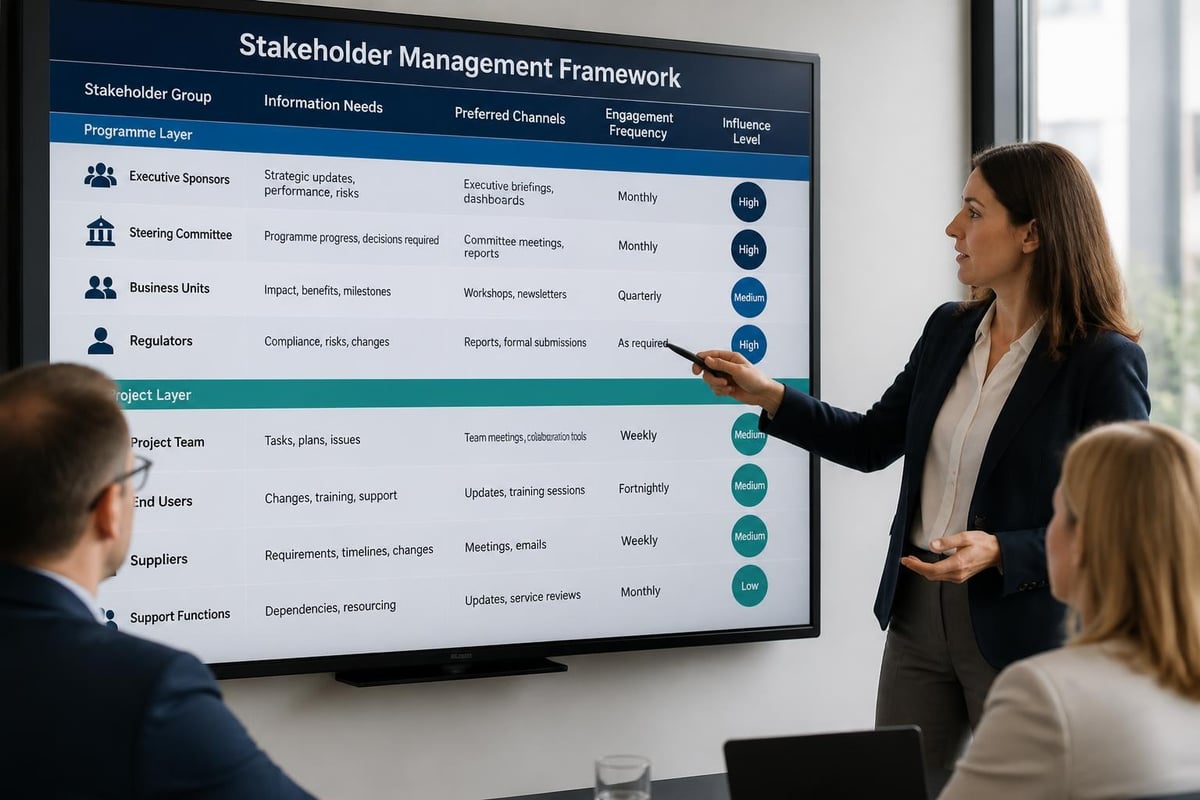
Program and project management require different stakeholder strategies. Projects typically engage a focused group with direct interest in specific deliverables. Programmes must coordinate diverse stakeholders with varying and sometimes conflicting interests across multiple workstreams.
Mapping Stakeholder Complexity
Programme stakeholders include project sponsors, operational teams affected by individual projects, end users, executive sponsors, external partners, and regulatory bodies. Each group requires tailored communication addressing their specific concerns and decision-making needs.
The importance of everyday interactions in stakeholder management cannot be overstated. Formal governance meetings provide structure, but informal conversations, responsive updates, and proactive issue flagging build the trust that sustains programme momentum through inevitable challenges.
Communication Cadence and Channels
Effective program and project management establishes clear communication rhythms that inform without overwhelming stakeholders.
Programme-level communication:
- Executive dashboard: monthly strategic summary
- Benefit tracking: quarterly progress reports
- Risk register: monthly updates with mitigation status
- Stakeholder forums: bi-monthly engagement sessions
- Exception reports: immediate escalation of critical issues
Project-level communication:
- Status reports: weekly or fortnightly updates
- Team standups: daily synchronisation
- Sprint reviews: iteration-based demonstrations
- Steering meetings: monthly or bi-monthly governance
Procurement and Vendor Management
Large programmes typically involve multiple external suppliers delivering different components. The World Bank’s procurement guidance provides comprehensive frameworks for contract packaging and supplier coordination in complex delivery environments.
Contract Structures and Alignment
Program and project management must address vendor relationships at both tactical and strategic levels. Individual projects manage supplier deliverables against specific contracts, whilst programme oversight ensures vendors work collaboratively toward common objectives rather than optimising their individual contracts at programme expense.
Master service agreements at programme level provide governance frameworks, whilst project-specific statements of work define detailed deliverables. This two-tier approach balances flexibility with accountability.
Managing Cross-Vendor Dependencies
When multiple suppliers contribute to integrated solutions, dependency management becomes critical. Programme managers facilitate coordination that individual vendors cannot achieve independently, resolving interface conflicts and ensuring compatibility across supplier deliverables.
Tools and Technology Enablement
Modern program and project management demands integrated technology platforms rather than fragmented point solutions. Spreadsheets and disconnected tools create data inconsistency, duplicate effort, and visibility gaps that undermine governance effectiveness.
Platform Requirements for Programme Delivery
Comprehensive platforms supporting program and project management must provide:
- Unified data model connecting projects, resources, time, and finances
- Hierarchical visibility from task-level detail through project summaries to programme dashboards
- Flexible methodology support accommodating different delivery approaches
- Real-time reporting eliminating manual consolidation and version control issues
- Integrated time tracking capturing effort across multiple projects
- Client and stakeholder portals providing appropriate visibility without internal system access
Teams transitioning from task-based tools to comprehensive platforms often discover that features considered “nice to have” become essential as programme complexity increases.
Integration and Data Flow
No single platform addresses every organisational need. Effective program and project management technology strategies emphasise integration over consolidation. Critical integrations include financial systems for budget tracking, HR systems for resource data, and collaboration platforms for document management.
The challenge of making platforms work together intensifies at programme scale, where data flows across more systems and stakeholders. API-based integration strategies outperform manual data transfers, reducing errors and improving timeliness.
Reporting and Performance Management
Program and project management generate vast quantities of data. Transforming this data into actionable insights requires thoughtful reporting design that serves different stakeholder needs without creating reporting headaches.
Dashboard Design Principles
Effective dashboards follow the “three-second rule”-critical information should be comprehensible within three seconds of viewing. This demands visual design that highlights exceptions and trends rather than overwhelming viewers with comprehensive data.
Dashboard components by audience:
| Stakeholder Level | Key Metrics | Update Frequency | Format |
|---|---|---|---|
| Executive | Programme RAG status, benefits realisation %, budget variance | Monthly | Single-page summary with exception details |
| Programme Board | Project health, resource utilisation, critical risks | Fortnightly | Multi-page dashboard with drill-down |
| Project Manager | Task completion, team capacity, upcoming milestones | Weekly | Detailed operational view |
| Delivery Team | Sprint progress, impediments, upcoming work | Daily | Real-time task board |
Predictive Analytics and Forecasting
Forward-looking program and project management relies on predictive capabilities beyond historical reporting. Trend analysis of velocity, burn rates, and resource consumption enables proactive intervention before projects deteriorate into crisis recovery mode.
Machine learning algorithms now enhance forecasting accuracy, identifying patterns that human analysis might miss. These capabilities transform programme management from reactive firefighting to proactive risk mitigation.
Building Organisational Maturity
Sustainable program and project management capability requires organisational commitment beyond individual project success. Maturity models provide roadmaps for progressive capability development.
Capability Assessment and Development
Organisations progress through maturity stages from ad-hoc delivery through defined processes to optimised, data-driven programme management. Self-assessment against established frameworks identifies capability gaps and prioritises improvement initiatives.
Maturity dimensions:
- Methodology consistency and adoption
- Governance effectiveness and decision quality
- Resource management and capacity planning
- Benefits realisation and outcome focus
- Tool integration and data quality
- Risk management and issue resolution
- Stakeholder engagement and communication
Learning from Delivery Experience
Post-implementation reviews and retrospectives capture lessons that inform future programme design. Many organisations conduct these exercises but fail to systematically apply learnings to subsequent initiatives.
Creating accessible repositories of lessons learned, decision rationales, and effective practices enables teams to avoid repeating mistakes whilst accelerating adoption of proven approaches. The concept of reducing uncertainty through systematic learning applies at both project and programme levels.
Change Management Within Programmes
Program and project management increasingly recognises that technical delivery represents only part of successful transformation. Organisational change management ensures people adopt new capabilities and realise intended benefits.
Adoption Strategies and Resistance Management
Programmes introducing new systems or processes encounter resistance rooted in legitimate concerns about competence, workload, and job security. Effective change management addresses these concerns through communication, training, and support structures that build confidence.
Change enablement activities:
- Stakeholder impact analysis identifying who changes affect and how
- Change champion networks providing peer support and local expertise
- Phased rollout approaches allowing learning and adjustment
- Training aligned to role requirements rather than generic system overviews
- Support structures providing assistance through transition periods
Sustaining Change Beyond Programme Closure
Programmes risk benefits erosion if new ways of working gradually revert to previous practices. Embedding change requires operational ownership, performance monitoring, and ongoing reinforcement beyond formal programme timelines.
Programme governance should include explicit transition planning that transfers accountability from programme structures to business-as-usual management before formal closure.
Mastering program and project management enables organisations to deliver complex change whilst maintaining operational excellence. The strategic coordination of programmes combined with rigorous project execution creates the foundation for sustainable competitive advantage. Chronodesk provides professional teams with the integrated platform capabilities required for effective program and project management, from resource allocation and time tracking through to client management and benefit realisation. Discover how Chronodesk can elevate your delivery capability and drive measurable business outcomes.